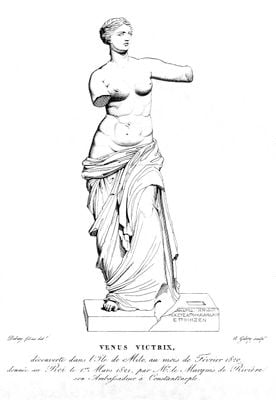
Venus de Milo, Ancient Greek marble statue in Louvre Museum, France.
Venus de Milo is a female marble figure from ancient Greece now displayed at the Louvre in Paris. The sculpture measures roughly two meters in height and shows a female body with missing arms and a garment falling from the hips with detailed folds.
A Greek farmer and a French naval officer found the figure in 1820 on the island of Milos, which led to its acquisition by the French ambassador. After arriving in Paris, it quickly became one of the most recognized works of ancient sculpture in French possession.
Visitors gather around the figure in large groups and photograph it from different angles, as it ranks among the most celebrated works in the museum. This attention becomes especially noticeable during peak hours, when people from every continent stand before the sculpture and treat its presence as an essential part of their Paris visit.
The figure stands in Room 345 of the Louvre and can be viewed from different directions without separating barriers. On days with heavy visitor traffic, arriving outside peak hours or waiting nearby until the crowd thins can make viewing easier.
The figure consists of two separate blocks of Parian marble joined together. Small holes on the surface suggest that metal jewelry or other elements were once attached and are now lost.
The community of curious travelers
AroundUs brings together thousands of curated places, local tips, and hidden gems, enriched daily by 90,799 contributors worldwide.