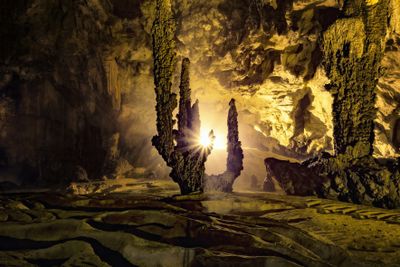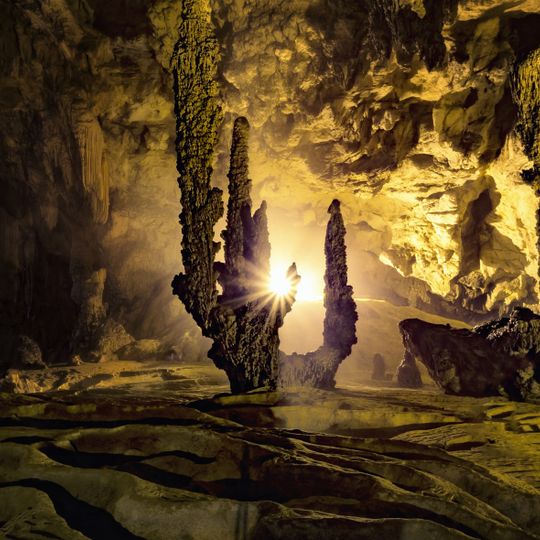
Nguom Ngao Cave, Natural limestone cave in Trùng Khánh, Vietnam.
Nguom Ngao is a natural limestone cave in Trùng Khánh with three entrances and chambers reaching heights of 60 meters. The complex contains mineral formations throughout its underground passages and extends over a substantial length.
Local residents discovered the cave in 1921, but the public could only visit from 2006 onward after pathways were constructed. This opening to visitors made the underground system accessible for the first time to the wider population.
The name comes from the Tay ethnic minority language and references old stories about tigers sheltering in the cave. These tales remain part of local memory and shape how people understand the place today.
Bring a flashlight and warm clothing for the one-hour exploration, as the electrical lighting system is still being developed. Temperatures inside remain cool regardless of the season outside.
The stone formations resemble natural objects like boats, forests, rice terraces, and animals in surprisingly convincing ways. Visitors discover these shapes while moving through the chambers and find themselves creating their own interpretations.
Location: Trùng Khánh
GPS coordinates: 22.84567,106.70570
Latest update: December 6, 2025 17:42
Vietnam extends more than 1,000 miles (1,600 kilometers) from mountain regions in the north to the Mekong Delta in the south, offering travelers a wide range of natural and historical sites beyond urban centers. The country includes Buddhist temples like Bai Dinh and Thien Mu Pagoda, cave systems such as Son Doong and Hang En, and rice terraces at Y Ty and Hoang Su Phi. Geographic features span from limestone formations in Ninh Binh to coastal areas at Phu Quoc and Ly Son islands, and waterfalls at Ban Gioc along the Chinese border. Historical sites document different periods of Vietnamese history. The Imperial Citadel of Thang Long in Hanoi preserves royal palace remains, while Po Nagar Cham Towers in Nha Trang date to the 7th century. My Son Sanctuary in Quang Nam holds temple ruins from the Champa civilization, and Cu Chi Tunnels near Ho Chi Minh City served as an underground network during the Vietnam War. The Mekong Delta in the south consists of waterways, floating markets and traditional villages, while Mui Ne sand dunes and Lang Co Beach present different coastal landscapes.
Ban Gioc–Detian Falls
2.1 km
Nui Coc Lake
175.3 km
Tam Đảo
185.5 km
Friendship Pass
96.8 km
Chùa Vĩnh Nghiêm
185.8 km
Ham Long Buddhist temple
199.2 km
Tam Dao National Park
189.9 km
Ba Bể National Park
122.3 km
Rock Paintings of Hua Mountain
72.2 km
牡宜遗址
181 km
Tra Linh checkpoint
39.2 km
Ka Long Bridge
195.8 km
Mount Yen Tu
187.5 km
Guangxi Finance Plaza
171.7 km
Nanning Mosque
165.1 km
Longbang Port
39.3 km
Diwang International Commerce Center
170.3 km
Ky Cung Bridge
110.9 km
The Complex of Yen Tu Monuments and Landscape
196.9 km
Thanh Chuong Viet Palace
197.9 km
Yantan Dam
156.4 km
Vat Bridge
189 km
Cathedral of Our Lady of China
167.5 km
Église du Sacré-Cœur-de-Jésus de Nanning
167.5 km
Guangxi Zhuang Autonomous Region Museum
167 km
Nanning Bridge
170.7 km
Ha Giang provincial museum
176.6 km
Yongjiang Bridge
182.8 kmVisited this place? Tap the stars to rate it and share your experience / photos with the community! Try now! You can cancel it anytime.
Discover hidden gems everywhere you go!
From secret cafés to breathtaking viewpoints, skip the crowded tourist spots and find places that match your style. Our app makes it easy with voice search, smart filtering, route optimization, and insider tips from travelers worldwide. Download now for the complete mobile experience.
A unique approach to discovering new places❞
— Le Figaro
All the places worth exploring❞
— France Info
A tailor-made excursion in just a few clicks❞
— 20 Minutes