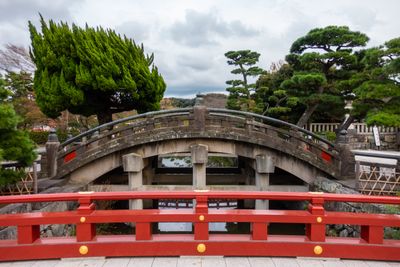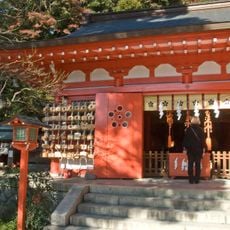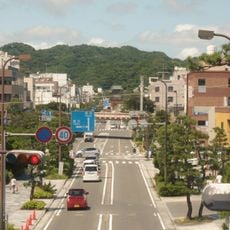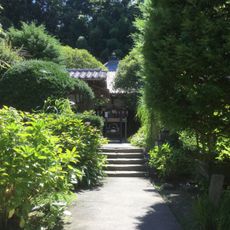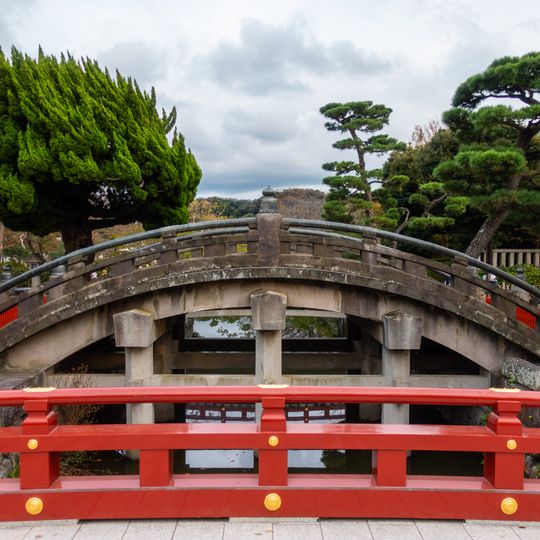
Taiko-bashi, Stone bridge at Tsurugaoka Hachimangu shrine, Kamakura, Japan
Taiko-bashi is a stone bridge at the entrance of Tsurugaoka Hachimangu shrine in Kamakura, featuring a distinctive curved arch design. Its name comes from its resemblance to a taiko drum when viewed from certain angles.
The bridge was built between 1764 and 1770 by merchants from the Hatchobori neighborhood during the Edo period. It represents the stonework craftsmanship of that era and reflects the urban development taking place in Kamakura at the time.
The bridge marks the entrance to Tsurugaoka Hachimangu shrine, where visitors cross over into the sacred grounds dedicated to Hachiman. Pilgrims and travelers pass through this threshold as a natural part of their journey through the shrine complex.
When visiting the shrine, crossing this bridge is part of the natural route for entering the sacred grounds. The access is open and the location is conveniently situated near bus stops and railway stations throughout the Kamakura area.
The artist Hasegawa Settan captured detailed images of this bridge between 1834 and 1836, documenting its daily role in the area. These artistic records offer visitors a glimpse into how the bridge and surrounding space looked during that earlier era.
Location: Kamakura
GPS coordinates: 35.32398,139.55514
Latest update: December 6, 2025 19:05
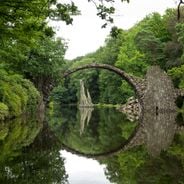
Moon bridges form semicircles that reflect as complete circles in the water. These structures originated in East Asia and combine practical function with deliberate design. The constructions appear in public gardens, botanical spaces and historic landscapes from Japan to California. The collection includes examples from different countries and periods. In Tokyo, the Drum Bridge spans a pond in Golden Gate Park, while the bridge at Kameido Tenjin Shrine forms part of a traditional shrine complex. Dahu Park in Taipei and Rikugien Garden in Tokyo show further variations of this building form. In China, examples range from the Jade Belt Arch in Beijing to multi-arched structures like the Twenty-Four Arch Bridge in Yangzhou. The Anshun Lang Bridge in Chengdu and the Stone Moon Bridge in Suzhou document different regional building styles. The form spread beyond Asia into botanical gardens and park settings worldwide. In the United States, moon bridges appear at Kubota Garden in Seattle, the Huntington Library in San Marino, and as the Humpback Bridge in Virginia. The Japanese garden in Toulouse presents a European example, while Hamilton Gardens in New Zealand holds the southernmost variation. Taiko Bashi in Kanagawa and Sorihashi in Sumiyoshi rank among the most traditional Japanese versions. Each location demonstrates its own interpretation of this architectural form.
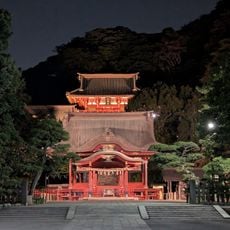
Tsurugaoka Hachiman-gū
261 m
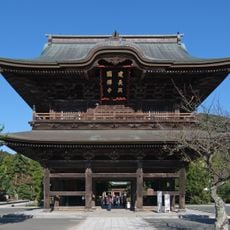
Kenchō-ji
869 m
Jufuku-ji
458 m
Myōhon-ji
715 m
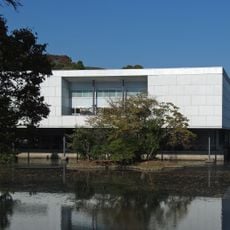
Museum of Modern Art, Kamakura & Hayama
86 m
Hongaku-ji
781 m
Egara Tenjinsha
858 m
Wakamiya Ōji
957 m
Tōshō-ji
537 m
Ennō-ji
674 m
Eishō-ji
497 m
Kamakura Castle
915 m
Jōkōmyō-ji
475 m
Shōchōju-in
679 m
Kamakura Museum of National Treasures
188 m
Kobukurozaka
507 m
Daigyō-ji
662 m
Chōju-ji
924 m
Shirahata-jinja
576 m
Myōryū-ji
376 m
鎌倉御用邸
938 m
Jōei-ji
904 m
Tomb of Minamoto no Yoritomo
597 m
Yakuō-ji
717 m
Hōkai-ji
326 m
The Museum of Modern Art Kamakura Annex
403 m
Kamegayatsuzaka
834 m
建長寺梵鐘
770 mReviews
Visited this place? Tap the stars to rate it and share your experience / photos with the community! Try now! You can cancel it anytime.
Discover hidden gems everywhere you go!
From secret cafés to breathtaking viewpoints, skip the crowded tourist spots and find places that match your style. Our app makes it easy with voice search, smart filtering, route optimization, and insider tips from travelers worldwide. Download now for the complete mobile experience.
A unique approach to discovering new places❞
— Le Figaro
All the places worth exploring❞
— France Info
A tailor-made excursion in just a few clicks❞
— 20 Minutes