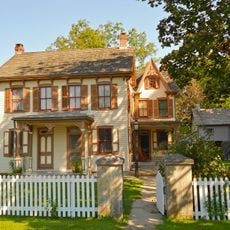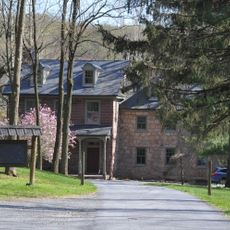
The Hess Homestead, Historic Mennonite farmstead in Lancaster County, United States.
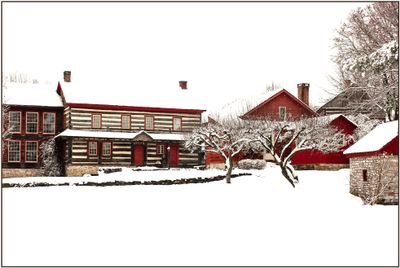
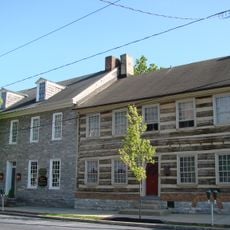
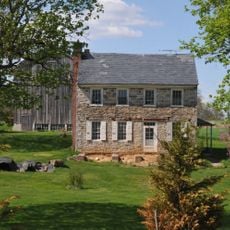
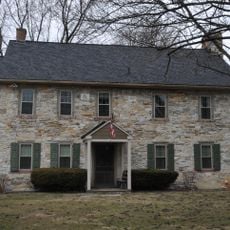
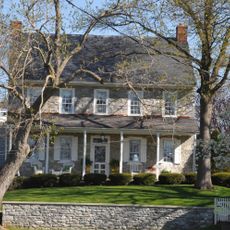
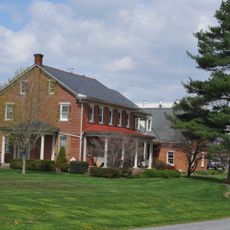
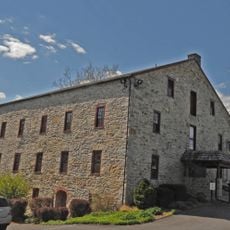
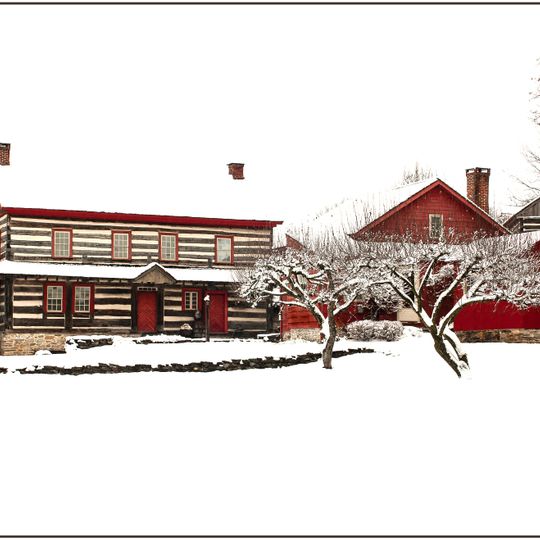
The Hess Homestead is a Mennonite farmstead near Lititz, Lancaster County, Pennsylvania, with a ca. 1744 log farmhouse, a 1778 stone farmhouse next door, a ca. 1850 frame summer kitchen, and a 1769 oil mill on adjoining properties. The two-story log house has dark and light horizontal log walls, a red roofline, a stone foundation, a central entrance with a small gabled hood on posts, a red door with a dark diamond pattern, and two brick chimneys.
The tract was first surveyed in 1730 as 200 acres for Hans Hess, who had immigrated in 1717 with his wife Magdalena; the family received title from William Penn's sons in 1735. Their son Jacob built the first house in the 1730s, and the present log farmhouse followed around 1744 for his widow Veronica. A stone farmhouse dated 1778 with the initials C. H. was built for Christian Hess, and the homestead stayed in the family until 1922, returning in 1985 when Clarke E. Hess bought and restored it.
The log and stone farmhouses doubled as meeting houses for the local Mennonite congregation until 1856, when the first Hess Mennonite church was built nearby. Mennonite preacher Jonas Hess, who owned the farmstead with his wife Annie Franck Hess, is one of the family members tied to that congregation. The German room names survive in the log house: Kueche (kitchen), Stube (stove room) and Arbeitsraum (work room).
The buildings stand on several adjoining private properties along Lititz Run Road, so the log farmhouse, the 1778 stone farmhouse and the 1769 oil mill are not a single open site. The log house's front door opens into a central hallway, the durchgaengiges Haus plan, with the Kueche, Stube and Arbeitsraum around it; the stone house next door has 1778 and the initials C. H. carved in its gable datestone.
The log farmhouse showcases a rare German construction method called Blockstanderbau that uses vertical wooden posts at the corners rather than full-length horizontal logs. This building technique was common in the early colonial period but was gradually replaced by other methods, making surviving examples like this quite scarce.
The community of curious travelers
AroundUs brings together thousands of curated places, local tips, and hidden gems, enriched daily by 92,993 contributors worldwide.