Al-Ukhaidir Fortress, Abbasid fortress in Karbala Governorate, Iraq.
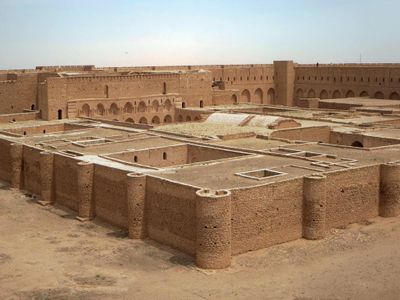
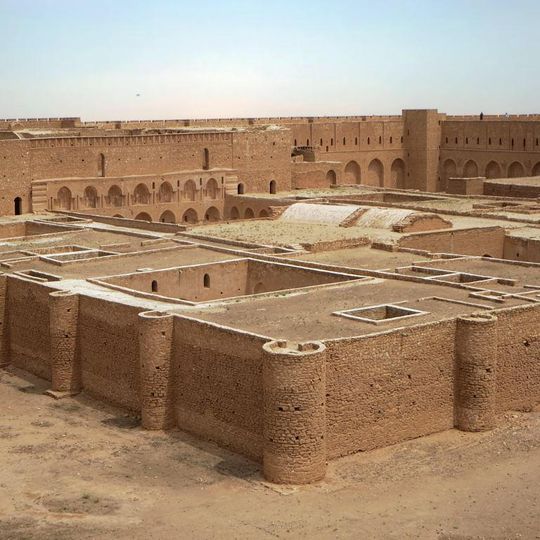
Al-Ukhaidir is a rectangular Abbasid fortress of pale tan brick and stone rising from the desert about 50 km southwest of Karbala. Its flat-topped walls, with rounded towers including a cylindrical one at the near corner, enclose a courtyard divided by interior walls into adjoining sections, some under flat roofs. Rows of small arched openings and blind arcades run along the upper facade, with larger arched doorways at ground level.
The fortress was founded in 775 and served as a military stronghold and royal residence along important trade routes during the Abbasid period. It played a role in controlling and protecting trade networks in the region over several centuries.
The name Al-Ukhaidir means "the green", after the land it stands on, while the neighbouring area is called Al-Abyad, "the white", for its pale sands and harvest. The mosque inside is part of the original build, with a small mihrab on each side and a covered sanctuary, which argues against dating the site before the Islamic conquest of Iraq.
The complex measures about 175 by 169 metres, with the main palace block roughly 112 by 83 metres, so allow time to walk between the outer wall and the central courtyard. Excavators cleared debris from the north gate using carts on a railway track, and that gate is the way in. Ground inside is sandy and uneven; bring water and sun protection.
Gertrude Bell visited in 1909 and wrote the first major report on the ruins; the site entered the UNESCO World Heritage Tentative List on 7 July 2000. The name may refer to Isma'il ibn Yusuf al-Ukhaidhir of the Banu Ukhaidhir, who rebelled against the Abbasids and later governed Kufa with Qarmatian support.
The community of curious travelers
AroundUs brings together thousands of curated places, local tips, and hidden gems, enriched daily by 92,624 contributors worldwide.