Imam Husayn Mausoleum, Islamic mausoleum and mosque in Karbala, Iraq.
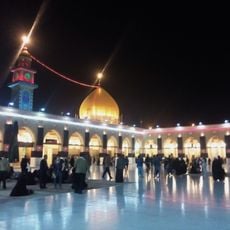
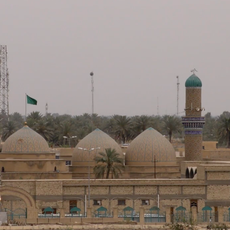
The Imam Husayn Mausoleum is a tomb and mosque in Karbala, Iraq, formed by several connected buildings with a large golden central dome. The prayer halls and courtyards feature blue and turquoise tilework and Arabic script on walls and arches.
The site marks the location where Hussein ibn Ali died in 680 during the Battle of Karbala. Over the centuries, the building was expanded and rebuilt several times after destruction.
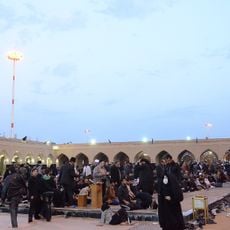
The name refers to Hussein ibn Ali, a central figure in Shia Islam, whose tomb draws pilgrims from around the world. Visitors see worshippers praying, touching the grille walls, and standing quietly in the inner courtyards.
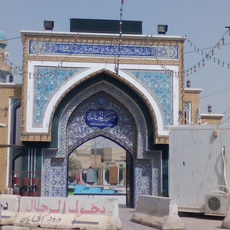
The shrine has ten gates: two on the south side (Bab al-Qiblah and Bab al-Rahmah), three on the west (Bab al-Zaynabiyyah, Bab Ra's al-Husayn, Bab al-Sultaniyyah), two on the north (Bab al-Sidrah, Bab al-Islam) and three on the east (Bab al-Karamah, Bab al-Shuhada, Bab Qadi al-Hajat). The space between this shrine and the Al-Abbas Shrine to the northeast is called Bayn al-Haramayn. Crowds peak during Muharram and the Arba'in pilgrimage, when up to 35 million pilgrims reach Karbala.
Above the burial chamber hangs a metal grille structure decorated with precious stones and metals donated by followers over centuries. These gifts form a shining layer that sparkles when light falls on it.
The community of curious travelers
AroundUs brings together thousands of curated places, local tips, and hidden gems, enriched daily by 92,748 contributors worldwide.