Kong Hock Keong Temple, Taoist temple in George Town, Malaysia
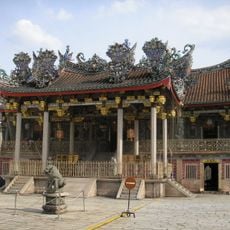
Kong Hock Keong Temple is a Chinese temple on Pitt Street in George Town, Penang. Its high roof has dragon figurines on the top ridges, and dragon-entwined pillars support it. Large doors are painted with Taoist and Buddhist deities. A large courtyard faces Pitt Street to the east, and the layout follows feng shui principles.
The temple was founded in 1800 at a cost of $4,000 Spanish dollars, built by Hokkien seafarers for Mazu, patron of seafarers, when Penang Island was sparsely populated and the site stood close to the sea. A renovation in 1824 changed the main deity from Mazu to Guan Yin and added Guan Yu and Tua Pek Kong, reflecting George Town's more diverse Chinese community. A committee with equal Hokkien and Cantonese representation ran it as council and tribunal until the mid-19th century, when the Penang Chinese Town Hall, founded in 1881 after the 1867 riots, took over that secular role.
The temple's name Kong Hock Keong refers to the Hokkien and Cantonese communities that jointly ran it, with a committee of equal numbers from both groups. It still hosts the annual feast days for Guan Yin and the Jade Emperor's Birthday, drawing devotees from across Southeast Asia.
The temple faces east onto Pitt Street, with a large courtyard in front of the main hall. The courtyard well is for public use, while the well beside the main shrine is reserved for monks. The temple was last renovated between 2012 and 2017.
The grounds contain three ancient wells, including one beneath the main altar that local tradition says has healing powers. These hidden water sources often surprise visitors who explore the temple grounds.
The community of curious travelers
AroundUs brings together thousands of curated places, local tips, and hidden gems, enriched daily by 92,563 contributors worldwide.