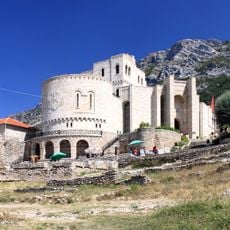
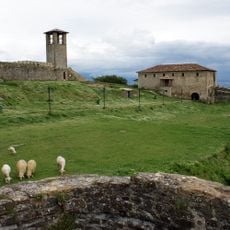
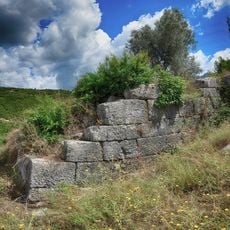
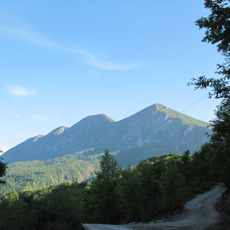
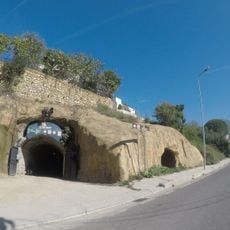
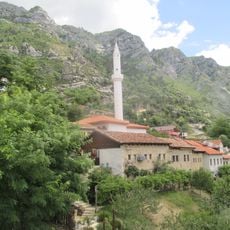
Teqe of Dollme, Religious structure at Krujë Castle, Albania.
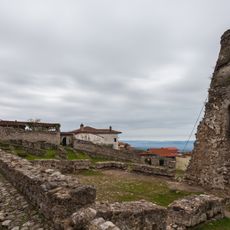
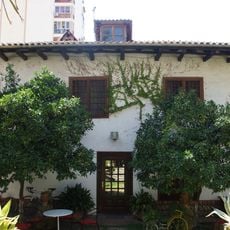
The Teqe of Dollme is a Bektashi tekke in the southern corner of Kruja Castle, of which the single-domed türbe of Haxhi Mustafa Baba survives. Its square stone walls measure 7.20 m, the shallow dome rests on a low octagonal drum, and the interior walls are decorated with floral scrolls and inscriptions. A small garden with graves and an old hammam stand beside it.
Built in 1193 AH (1779/1780 CE) by Adem Aga Toptani, whose marble tomb stands inside, the tekke may first have served as a mosque, since a mihrab remains in the prayer space. Before the Communist dictatorship it held 360 holy graves and was called "Little Khorasan". Closed in 1967 under the ban on religion, it reopened in December 1990 as the country's first tekke, was damaged by the 2019 earthquake and restored in 2022.
Pilgrims gathered here on 11 August, the feast day of the tekke, and the graves of Baba Mustafa Dollma and the dervish Hysen Dollma are revered as shrines. The tekke was known as "Little Khorasan" and held 360 holy graves before its destruction under the Communist dictatorship. It reopened in December 1990 as the first tekke in the country to resume activity.
The building is located within the castle grounds and is accessible during daylight hours when the castle itself is open to visitors. It is best to combine a visit here with exploring the larger castle complex, as the two sites are adjacent to each other.
The tekke once held 360 holy graves and was called "Little Khorasan". In its garden stands an olive tree bearing Skanderbeg's name, said to be over 1,000 years old, and an old hammam stands beside the tekke.
The community of curious travelers
AroundUs brings together thousands of curated places, local tips, and hidden gems, enriched daily by 94,001 contributors worldwide.