Vivari Fortress, Ottoman fortress at Butrint, Albania
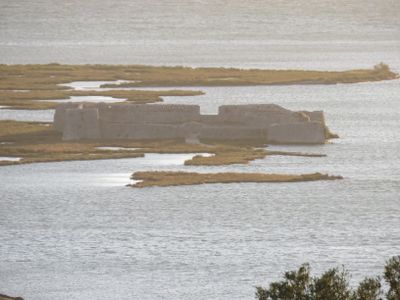
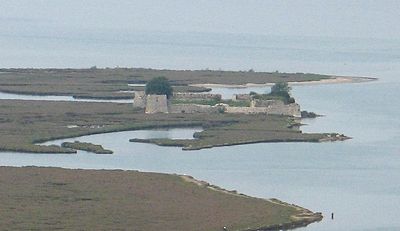
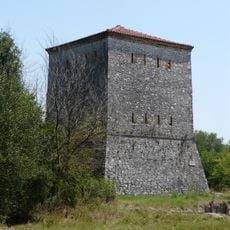
Vivari Fortress stands on a small flat island at the mouth of the Vivari Channel, about 2.4 km west of Butrint. Its light grey stone walls form a roughly rectangular plan: a lower front wall and a higher wall behind, topped by about ten evenly spaced rectangular openings and a taller square tower at the left end. A second, lower square tower projects from the right side, and grass grows around the base.
The Venetians built the fortress in the late 15th or early 16th century to exploit fishing, grazing, olives and timber around Butrint. It changed hands several times in conflicts with the Ottoman Empire, and a retreating French army destroyed it in 1798 to keep it from Ali Pasha. Ali Pasha seized the site around 1804, added gun batteries, and rebuilt the present fortress in 1819 with three towers; it served as his second residence until 1820.
The castle takes its name from Ali Pasha of Tepelenë, who held it until 1820 and used it as his second residence. It began as a fortified estate centre of a Corfiote family that farmed the plains south of Butrint, and Ali Pasha seized it around 1804.
The fortification attributed to Ali Pasha lies about 2.4 km due west of Butrint, at the mouth of the Vivari Channel, so it is reached by boat or on foot along the channel rather than from the archaeological site itself. The ground inside the walls is sandy and uneven, and the site offers little shade.
The fortification at the mouth of the Vivari Channel began in the late 17th or early 18th century as a fortified estate centre of a Corfiote family farming land south of Butrint. Ali Pasha seized it around 1804 and added gun batteries. Given its small size, it likely served mainly to control sea access to Butrint.
The community of curious travelers
AroundUs brings together thousands of curated places, local tips, and hidden gems, enriched daily by 92,624 contributors worldwide.