Baptistery of Butrint, Early Byzantine baptistery in Butrint, Albania
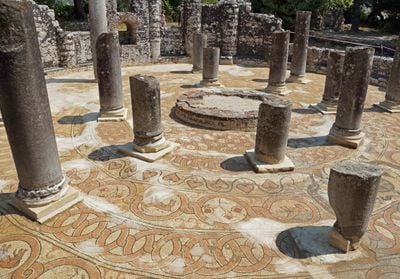
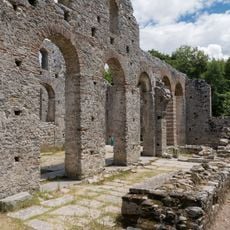
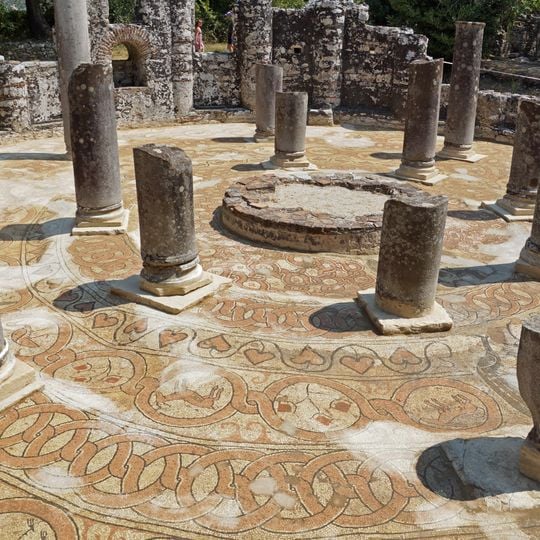
The Baptistery of Butrint is a circular early Byzantine structure approximately 14.5 meters in diameter, built with Egyptian granite featuring sixteen columns arranged in two concentric circles and twenty-four half-columns along the walls. At its center stands a cross-shaped font with two interior steps designed for baptismal ceremonies.
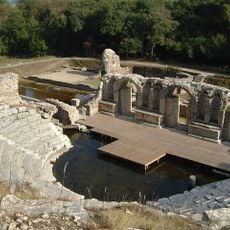
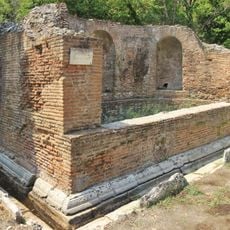
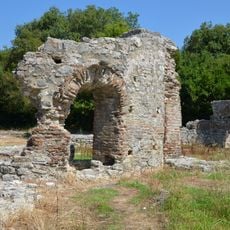
Built in the 6th century AD, the baptistery was raised inside a rectangular space that had belonged to a Roman bathhouse or household bathing complex; a small room to its northeast is identified as the caldarium of a hypocaust heating system. The round structure, 14.5 metres in diameter, was excavated in May 1928 by an Italian archaeological mission to Albania led by Luigi Maria Ugolini.
The mosaic was most likely laid by craftsmen from Nicopolis and is considered the most complex surviving late antique baptismal pavement in the Mediterranean. Peacocks flank a kantharos with vines and grapes, a symbol of eternal life because peacock flesh was believed not to decay; two stags at a fountain refer to Psalm 42. Other roundels show leopards, hunting dogs and nets, scenes of aristocratic hunting.
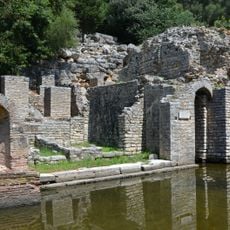
The mosaic pavement lies at the bottom of the excavated area, reached by paths through the Butrint archaeological site. The floor is often protected under a layer of sand or water, so the full pattern may not be visible on every visit. The columns stand in the open, and the ground around the rim can be uneven.
The two colonnades each held eight columns, and John Mitchell notes that no other building of the period takes this form: the wider spacing of the outer ring forced far wider and higher arches, which he links to the symbolic power of the number eight.
The community of curious travelers
AroundUs brings together thousands of curated places, local tips, and hidden gems, enriched daily by 92,705 contributors worldwide.