Casa de Pedro del Río Zañartu, Historical mansion museum in Concepción, Chile.
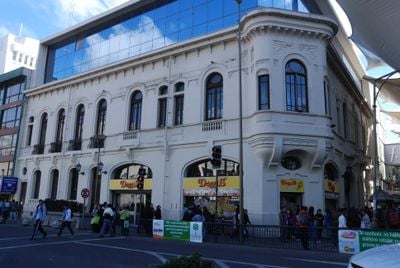
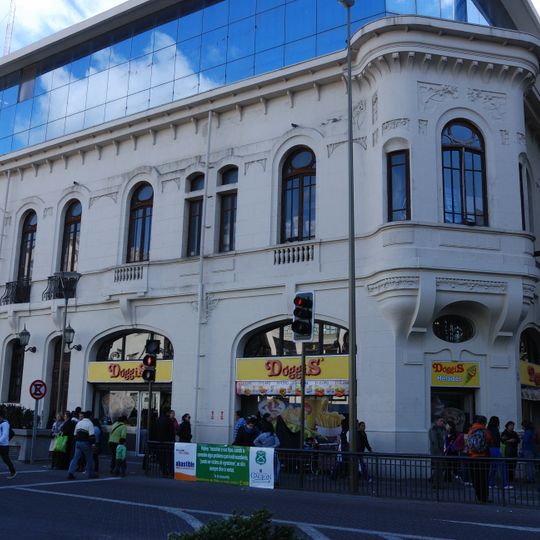
Casa de Pedro del Río Zañartu is a three-story mansion at the southwest corner of Barros Arana and Castellón streets in central Concepción. Architect Onofre Montané Urrejola combined neoclassical composition with Art Nouveau floral and leaf motifs on balconies, cornices and windows. The second-floor ochavo projects from the facade with concave and convex edges. Since 2007 only the facade remains original; the interior was emptied and rebuilt for a department store.
Pedro del Río Zañartu, a wealthy landowner, traveller and philanthropist from Concepción, commissioned architect Onofre Montané Urrejola to build the mansion; it was erected between 1915 and 1917 at the corner of Barros Arana and Castellón. Del Río died before completion, so his widow Carmen Urrejola lived there from 1918 and hosted a salon until her death in 1932, when the house was sold per her will. It survived the 1939 and 1960 earthquakes and was declared a National Historic Monument in 1995.
From 1918 Carmen Urrejola del Río, widow of Pedro del Río Zañartu, held a long-running tertulia in the house, gathering Concepción's intellectuals, artists and thinkers to debate painting, music, literature and the new currents of the 20th century. She died in 1932, and the house was sold to fulfil her will.
The house stands at the southwest corner of Barros Arana and Castellón streets, in the centre of Concepción. Since 2007 the interior was emptied for a department store, so only the facade survives; look for the second-floor ochavo and the floral Art Nouveau motifs on balconies, cornices and windows.
The mansion holds an Egyptian mummy and other rare objects that Pedro del Río collected during his travels around the world. These exceptional pieces are displayed alongside everyday items throughout the rooms, creating an intriguing contrast.
The community of curious travelers
AroundUs brings together thousands of curated places, local tips, and hidden gems, enriched daily by 94,418 contributors worldwide.