Descabezado Grande, Mountain summit in Maule Region, Chile.
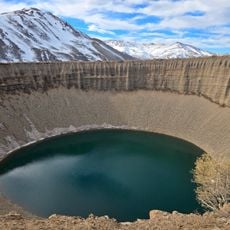
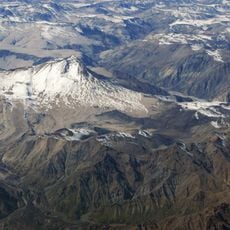
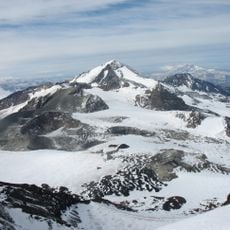
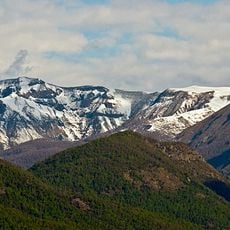
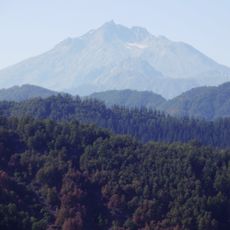
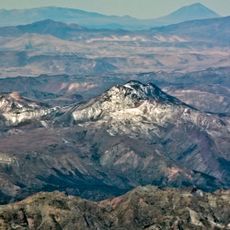
Descabezado Grande is a stratovolcano in the Maule Region of central Chile, 3,830 m high, whose top collapsed in an explosive eruption, leaving a flat, headless silhouette. Its summit holds an ice-filled caldera 1.4 km wide, with a smaller 500 m crater in the northeast that has active fumaroles. It is built of andesite and rhyodacite lava flows and pyroclastic deposits, with a basal diameter of about 10 by 12 km.
Descabezado Grande is a Pleistocene volcanic complex whose summit cone collapsed during an explosive eruption, leaving a caldera over a kilometre wide. Its secondary vent Quizapú, formed in 1846, produced the great eruption of 2 June 1932, when a 30 km column and some 25 cubic kilometres of pyroclastic material were ejected. Fourteen eruptions are recorded from 1846 to 1967, the last known one.
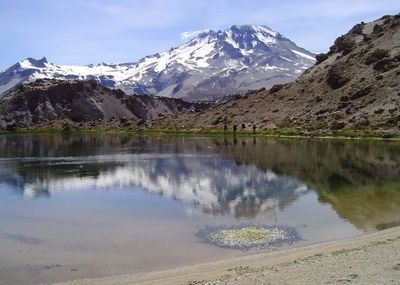
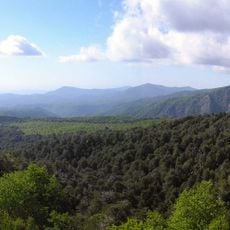
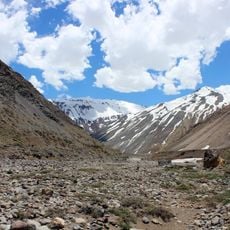
The volcano's name comes from its flat-topped profile, since descabezado means "headless" in Spanish. It is climbed from the Altos de Lircay park in Vilches, where the route to the summit covers about 44 km and takes some four days, with camps in the Valle del Venado and beside a dry lava river. Near the base sits a hot spring pool facing the mountain.
The best climbing season runs from December through March when weather conditions are more favorable. Technical gear and experienced mountaineers are needed to navigate the steep terrain safely.
The summit crater holds a glacier shaped like a crown, a form attributed to the force of the explosive eruption that removed the top of the old cone. The caldera is 1.4 km wide, with a smaller 500 m crater in its northeast part that still has active fumaroles.
The community of curious travelers
AroundUs brings together thousands of curated places, local tips, and hidden gems, enriched daily by 93,467 contributors worldwide.