Cerro Calán, Mountain summit in Las Condes, Chile
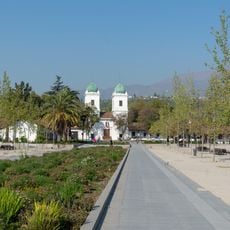
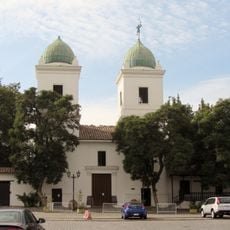
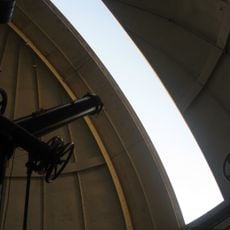
Cerro Calán is a hill in the Andean foothills above Apoquindo, in the Las Condes district of Santiago, reaching 867 meters above sea level. Its summit holds the Cerro Calán Observatory of the University of Chile, and a 1.2-meter radio telescope inaugurated in 2011 maps carbon monoxide in the southern sky. On the northern slope stands a cross-shaped building, the former Abbey of the Congregation of the Holy Cross, now used by the Carabineros police academy.
On 12 October 1962 a Soviet mission arrived at Cerro Calán with four telescopes and about ten astronomers. Earlier, in 1957, American researchers had come in connection with the International Geophysical Year. Federico Rutllant, director of the national observatory, persuaded the Carnegie institution to send a radio telescope, installed in Maipú as the first in South America, and then negotiated with the Soviets. The Department of Astronomy was created in 1965.
The observatory belongs to the University of Chile's Department of Astronomy, created in 1965. Since 30 September 2011 the department has run the community course "The Stars: What They Are, Their Life and Their Death" to bring astronomy closer to the public. Visits are arranged by prior registration with the department, on Mondays, Wednesdays and Fridays.
Visits to the summit observatory are arranged by the Department of Astronomy of the University of Chile, which registers interested visitors; tours run on Mondays, Wednesdays and Fridays. The hill lies in the Apoquindo sector of Las Condes, about 12 km northeast of central Santiago, and the northern slope holds the cross-shaped former Santa Cruz abbey, now the Carabineros police academy.
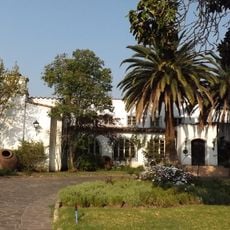
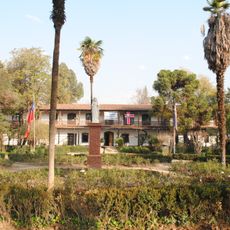
On the northern slope stands a cross-shaped building, the former Abbey of the Congregation of the Holy Cross, whose entrance road once curved in an S and is now Avenida Charles Hamilton. Benedictine monks arrived in 1955, and the abbey was built following the layout of Montecassino, which gave its name to Calle Montecassino. Today it houses the Carabineros Police Sciences Academy.
The community of curious travelers
AroundUs brings together thousands of curated places, local tips, and hidden gems, enriched daily by 92,627 contributors worldwide.