Puente Balta, Road bridge in Lima, Peru.
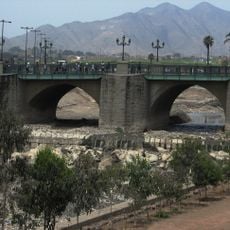
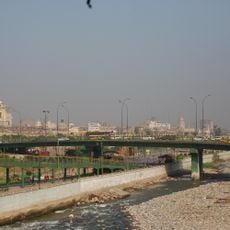
Puente Balta is an iron bridge with five arches spanning the Rímac River, connecting Jirón Amazonas in the south to Avenida 9 de Octubre in the north. The structure features cast iron construction with decorative details throughout its railings.
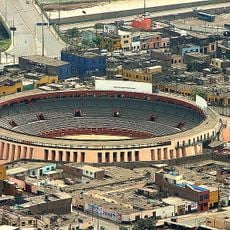
Studies for a new Rímac crossing began in 1868 under interim president Pedro Diez Canseco, since the colonial Puente de Piedra was then the only bridge linking Lima with the Rímac district. In 1869 José Balta's government held a public competition won by engineer Felipe Arancibia and businessman Enrique Armero, who had the ironwork cast in France by Boigues Rambourgs. The first stone was laid on 19 March 1869 at La Barranca, opposite the Plaza de Acho, and the first arch closed in October 1871; works finished in 1919 under Augusto B. Leguía.
The bridge's cast-iron arches carry spandrels filled with groups of rosettes, and the railings are pierced with quatrefoils, details the source attributes to neo-Gothic influence rather than classical models. Limeños also call it Puente de Fierro, the Iron Bridge, a name that stuck from its early years.
The bridge links Jirón Amazonas in the Cercado with Avenida Nueve de Octubre in the Rímac district, and the Acho side carries a ramp built because the engineers had not accounted for the height difference between the two banks. Pedestrians and vehicles share the deck, so cross with care.
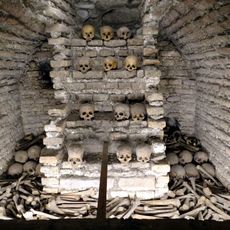
During the Chilean occupation of Lima in 1881, two Peruvian soldiers lost their lives here, and their remains now rest in a historical crypt. This connection to a pivotal moment in war makes the crossing hold deeper meaning for many visitors.
The community of curious travelers
AroundUs brings together thousands of curated places, local tips, and hidden gems, enriched daily by 92,787 contributors worldwide.