Old Pueyrredón Bridge, Road bridge in Avellaneda Partido, Buenos Aires, Argentina
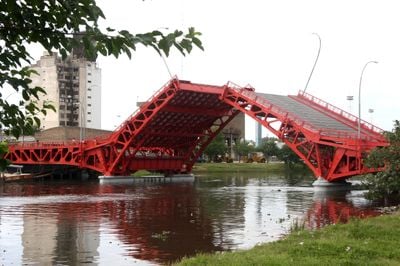
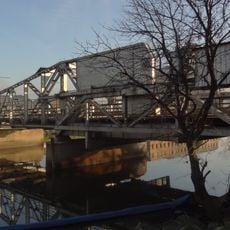
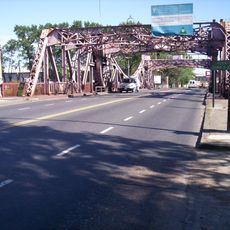
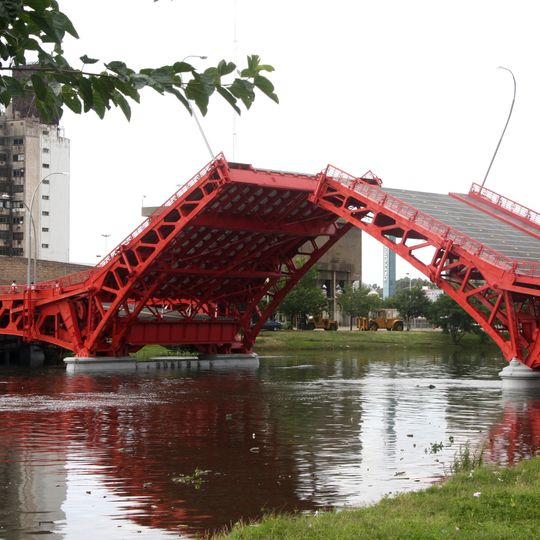
The Old Pueyrredón Bridge is a red steel bascule bridge over the Riachuelo, joining Vieytes Street in Barracas, Buenos Aires, with Bartolomé Mitre Avenue in Avellaneda. Its two raised leaves angle up and outward from opposite banks, each a dark gray roadway deck with red railings carried on a truss of intersecting diagonal beams. At the shallowest point each truss meets a massive red hinge anchored to a concrete pier set in the water.
The first bridge here opened on 1 December 1791, a wooden structure by Juan Gutiérrez Gálvez at the Paso de la Canoa, with a toll of two reales per loaded cart. Flooding destroyed it in 1858. Prilidiano Pueyrredón's iron bascule bridge, with parts forged in England, collapsed during testing in 1867; he died in 1870 before the replacement opened in 1871, and the 1884 flood swept that one away. The present bascule bridge was inaugurated on 20 September 1931.
The bridge is named after Prilidiano Pueyrredón, the painter and architect who proposed an iron bascule bridge here after the 1858 flood ruined the wooden Barracas bridge. He died in 1870, before his bridge opened in 1871, and the government gave it his name. Earlier it was called Puente de Gálvez, Puente de Madera and, under Rosas, Puente de la Restauración de las Leyes.
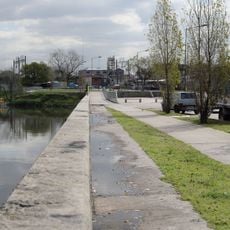
The bridge carries vehicles, bicycles and pedestrians between Vieytes Street in Barracas and Bartolomé Mitre Avenue in Avellaneda. Its bascule leaves have not been raised since 1969, so the crossing stays level. Expect heavy truck and bus traffic, and note that piquetes have repeatedly blocked this main link between the two cities.
The structure once had a bascule mechanism that could lift to let ships pass through the river. This lifting system operated until the late 1960s and reflects a time when the waterway served heavier shipping traffic.
The community of curious travelers
AroundUs brings together thousands of curated places, local tips, and hidden gems, enriched daily by 93,481 contributors worldwide.