Puente de la Mujer

Log in to your account

AroundUs is a community-driven map of interesting places, built by curious explorers like you. It grows with every review, story, and photo you share.
Connect to save your favorite spots, contribute locations, and create personalized routes.
By continuing, you accept our Terms and Conditions and our Privacy Policy
Add to collection
Map
Suggest a change
Share

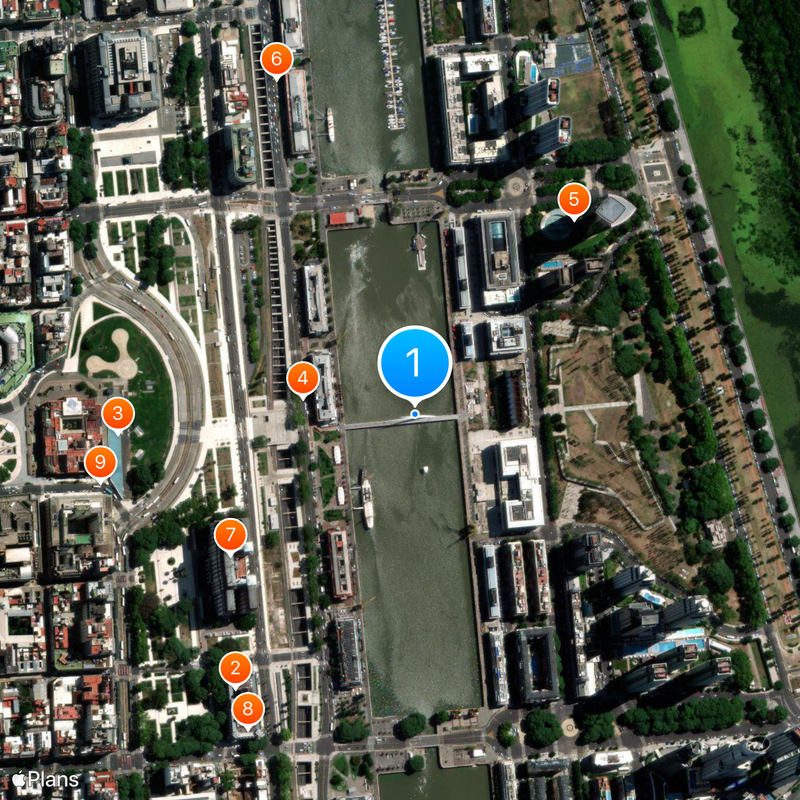
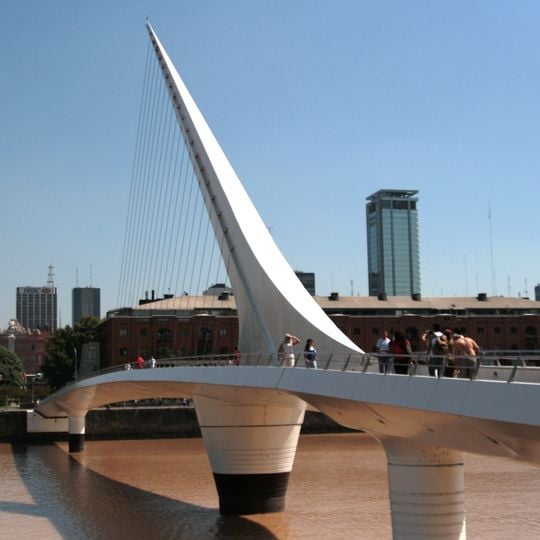
Puente de la Mujer, Rotating footbridge in Puerto Madero, Argentina.

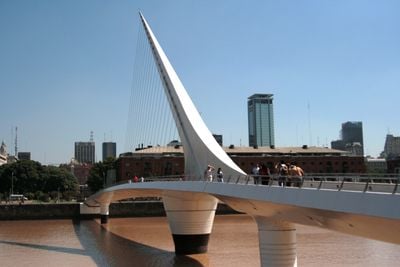
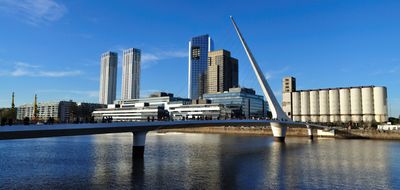
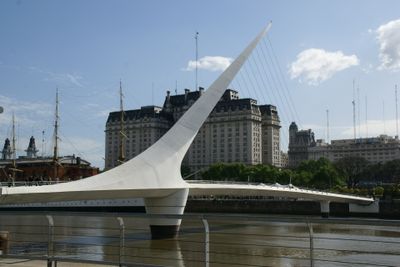
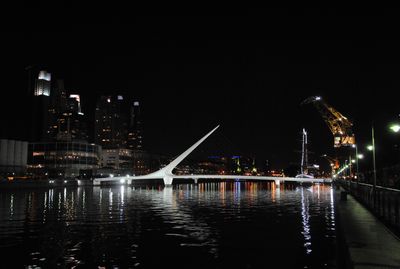
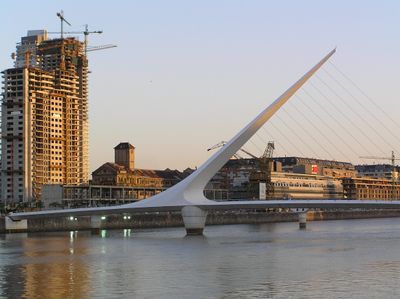
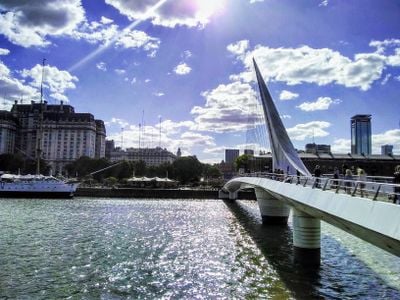
The Puente de la Mujer stretches 160 meters across Dock 3 with a white steel mast supporting cables that hold the central rotating section.

Built in Spain and opened on December 20, 2001, this bridge marks the transformation of Buenos Aires' waterfront from an industrial port to a modern district.

The bridge structure represents a tango dance, with the mast portraying the male dancer and the curved deck symbolizing his female partner.

The central span rotates 90 degrees on its axis to allow water vessels to pass through the channel between the docks of Puerto Madero.

Santiago Calatrava designed this asymmetrical cantilever bridge with a single mast system that combines engineering precision with mathematical calculations.

Location: Buenos Aires

Inception: December 20, 2001

Architects: Santiago Calatrava

Official opening: December 20, 2001

Height: 34 m

Length: 160 m

Longest Span: 100 m

Made from material: steel

Part of: Landmarks in Buenos Aires

GPS coordinates: -34.60794,-58.36491

Latest update: May 28, 2025 18:32

The most impressive bridges in the world

Bridges are a part of our daily lives. They have connected banks, valleys, and communities for centuries. This collection presents structures from various periods and regions. From medieval stone arches to modern steel constructions, these works demonstrate the evolution of engineering. The Rialto Bridge from the 16th century in Venice spans the Grand Canal with a single stone arch. The Golden Gate in San Francisco stretches over 1.7 miles (2.7 km), linking the city to northern California. In Singapore, the Helix Bridge forms a pedestrian link in Marina Bay with its double-helix structure. These structures serve practical purposes in urban transportation while shaping city skylines. They provide technical solutions to geographical barriers and reflect different approaches to bridge construction through the ages.

Frank Gehry buildings

Frank Gehry designs buildings with curved metal facades, irregular forms and experimental construction methods. His work defines urban spaces from Bilbao to Los Angeles. The exterior surfaces use titanium, steel or glass formed into wave-like or folded volumes. The interior spaces accommodate art collections, concert halls and commercial offices. The Guggenheim Museum in Bilbao displays titanium panels that reflect the light of the Basque coast. The Walt Disney Concert Hall in Los Angeles combines stainless steel surfaces with wooden acoustics for the Los Angeles Philharmonic. The Vitra Design Museum in Weil am Rhein demonstrates his early approaches with white stucco surfaces and angled walls. The buildings emerge through computer-aided design that translates complex geometries into buildable structures.

Neighborhoods of Buenos Aires: historical architecture, museums, and Japanese gardens

Buenos Aires reveals a patrimonial wealth that goes beyond the usual circuits. This collection gathers places that tell the story of the Argentine capital through its architecture, green spaces, and cultural institutions. From the XVIIIth-century tunnel network of El Zanjón de Granados to the 22 stories of Palacio Barolo, these sites reflect the city's urban evolution. The itinerary includes diverse sites such as Palermo's Japanese Garden with its ponds and pavilions, the Museo de Arte Español Enrique Larreta showcasing works from the Middle Ages to the 20th century, and the moving Floralis Genérica sculpture whose petals open at sunrise. Neighborhoods like San Telmo, Barracas, and Colegiales offer architectural discoveries such as 19th-century passages, facades decorated with mosaics on Calle Lanín, and the Mercado de las Pulgas filled with Argentine antiques. These locations allow exploring Buenos Aires beyond postcards and observe how the city has preserved its history while growing. Each site provides a different perspective on porteña culture, from Carlos Gardel’s tango to European and Asian influences shaping the city’s identity.

Reviews

Visited this place? Tap the stars to rate it and share your experience / photos with the community! Try now! You can cancel it anytime.

« Puente de la Mujer - Rotating footbridge in Puerto Madero, Argentina » is provided by Around Us (aroundus.com). Images and texts are derived from Wikimedia project under a Creative Commons license. You are allowed to copy, distribute, and modify copies of this page, under the conditions set by the license, as long as this note is clearly visible.

Discover hidden gems everywhere you go!

From secret cafés to breathtaking viewpoints, skip the crowded tourist spots and find places that match your style. Our app makes it easy with voice search, smart filtering, route optimization, and insider tips from travelers worldwide. Download now for the complete mobile experience.
Around Us App Screenshot

A unique approach to discovering new places

Le Figaro

All the places worth exploring

France Info

A tailor-made excursion in just a few clicks

20 Minutes