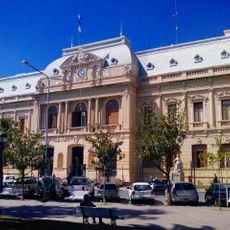
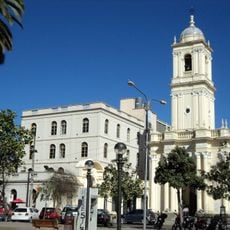
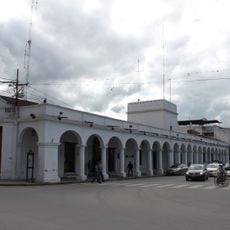
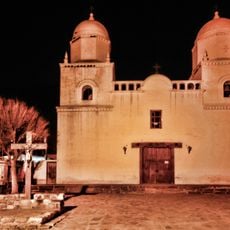
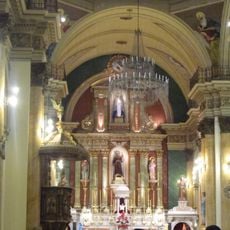
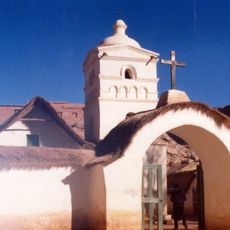
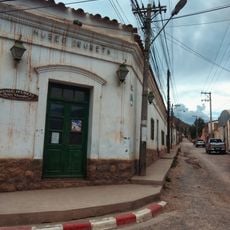
Cabildo de Humahuaca, Spanish colonial building in Humahuaca, Argentina.
The Cabildo de Humahuaca is a historic government building featuring a prominent clock tower with carved wooden details. The structure combines neoclassical elements with Moorish design influences throughout its exterior and interior spaces.
Humahuaca was a colonial villa whose cabildo, with an ordinary mayor, four regidores, a bailiff and a clerk, distributed land, levied municipal taxes and kept a militia. The earlier building, of adobe with straw and mud roof, cedar balconies and cardón wood ceilings, was demolished in 1934. The present cabildo was built from 1942 with national funds obtained in Buenos Aires by Dr. Ernesto Padilla, employing about twelve Humahuaca workers and others from San Salvador de Jujuy.
The niche above the Cabildo holds a carved wooden and chased bronze statue of San Francisco Solano by sculptor Antonio Gargiulo, one of the few articulated saint figures in the world. Its gears, weights and counterweights once made it move automatically. Dr. Ernesto Padilla, a student of the saint's life, proposed the niche so the musician saint could bless the square.
The Cabildo faces the central plaza of Humahuaca, in the historic centre. The present building dates from 1942, after the original adobe structure was demolished in 1934. Look for the carved condor columns in Coraya sandstone and the cedar-wood bell towers.
The statue in the niche is San Francisco Solano, not Francis of Assisi, and it is one of the few articulated saint figures known worldwide. Carved in wood with chased bronze by sculptor Antonio Gargiulo, it was originally automatic, moved by a system of gears, weights and counterweights. Dr. Ernesto Padilla, a student of the saint's life, proposed the niche so the saint could bless the plaza from above.
The community of curious travelers
AroundUs brings together thousands of curated places, local tips, and hidden gems, enriched daily by 92,785 contributors worldwide.