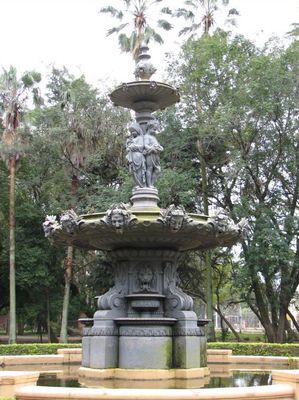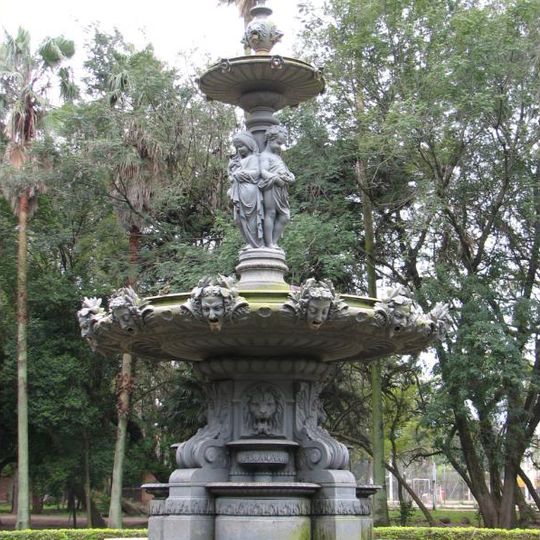
Fonte Francesa, French neoclassical fountain in Parque Farroupilha, Porto Alegre, Brazil.
Fonte Francesa is a cast-iron fountain with two main basins, set in the Recanto Europeu of Parque Farroupilha. Water pours from four lion-head spouts at the top into an upper basin, which has eight rose-shaped outlets. Below, three child figures stand close together, hiding the supporting column, and the large lower basin is adorned with angry faces and reeds.
Cast in France in 1866 by sculptor Carrier-Belleuse, the fountain was imported to Porto Alegre together with six other fountains. The other six disappeared without explanation in the late 19th century, leaving this as the only survivor. It stood at Praça da Alfândega, then Praça Paraíso (now Praça XV de Novembro) until 1925, then Praça Pereira Parobé, and after the 1941 flood was moved to its current site in the Recanto Europeu of Parque Farroupilha.
Three child sculptures with refined features decorate the fountain, reflecting the French artistic influence that shaped Porto Alegre's public spaces during the 19th century. These figures were part of a broader effort to bring European elegance to Brazilian urban design.
The fountain is located in the European Corner of Parque Farroupilha and is accessible throughout the day without admission fees. The park provides pathways and shaded areas to explore the surroundings comfortably.
The fountain's top is an oval pine cone from which water pours through four spouts shaped as lion faces. The upper basin carries eight outlets carved as small roses, and the base is cement ornamented with faces. The German text's claim of a fifth location is unsupported: the sources list Praça da Alfândega, Praça Paraíso, Praça Pereira Parobé and the current Recanto Europeu.
The community of curious travelers
AroundUs brings together thousands of curated places, local tips, and hidden gems, enriched daily by 93,276 contributors worldwide.