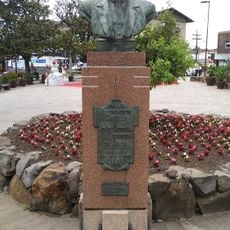
Monumento Nacional ao Imigrante, Bronze monument in Caxias do Sul, Brazil.
The Monumento Nacional ao Imigrante in Caxias do Sul consists of a bronze group of a farming couple with a child in the woman's arms, set before an obelisk with three allegorical bas-reliefs: land possession, land cultivation, and the alliance of civil and military forces under divine protection. The date 1875, the city's founding year, appears on the obelisk. Monumental staircases flank both sides, and a crypt below houses the Museu do Imigrante.
The idea was launched in 1949 by state deputy Luís Compagnoni on Rádio Caxias for the 75th anniversary of Italian colonization in Rio Grande do Sul. President Eurico Gaspar Dutra laid the cornerstone at the 1950 Festa da Uva, and after a competition Antônio Caringi's design was chosen. Built from 1951 to 1954, it was inaugurated by President Getúlio Vargas on 28 February 1954. Law 1.801 of 2 January 1953 extended the tribute to all ethnic groups.
The monument became a symbol honoring all ethnic groups who shaped Brazil through a 1953 law, moving beyond its initial focus on Italian immigrants. The reliefs visible on the structure represent these diverse contributions to society.
The monument stands at the city entrance on BR-116 at kilometre 150, with monumental staircases on both sides of the sculpture group. The crypt below is reached by these stairs, so visitors should expect steps rather than a level entrance.
The bronze door of the crypt features a portrayal of Luiz Antônio Feijó Júnior welcoming immigrants, a detail that many visitors miss. The marble walls were donated by the Italian government as a gift, reflecting the strong connection between the two countries.
The community of curious travelers
AroundUs brings together thousands of curated places, local tips, and hidden gems, enriched daily by 92,777 contributors worldwide.