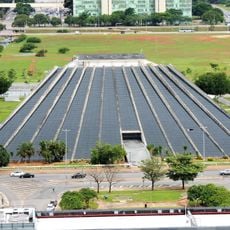
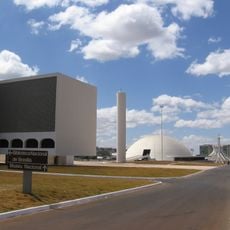
Planetário de Brasília, planetarium in Setor de Difusão Cultural, Brasília, Brazil
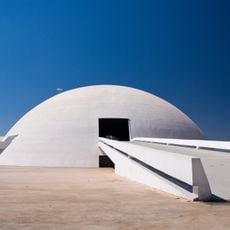
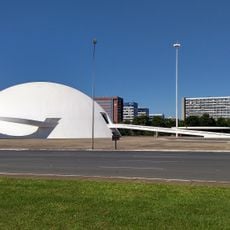
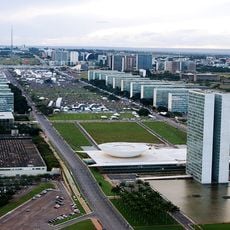
The Planetário de Brasília Luiz Cruls is a Brutalist building by Sérgio Bernardes, its exposed concrete shaped like a flying saucer on the Monumental Axis lawn. Two nested semi-spherical domes sit at the centre, ringed by sixteen identical volumes separated by one-metre radial strips, forming a hexadecagon whose faces mark the sixteen compass points. The inner dome, 12.5 m across, rests on a 2.3 m drum; the projection room seats 82.
The Planetário de Brasília Luiz Cruls was inaugurated on 15 March 1974, designed by architect Sérgio Bernardes. Its original project also planned sixteen aquariums on the upper floor to "unite sky and sea", but the glass-blade supports failed water tests and the aquarium idea was dropped. Closed for sixteen years, it underwent a major renovation between 2006 and 2013 and reopened on 11 December 2013 with a new Power Dome VIII projector.
The planetarium is named after Luiz Cruls, the Belgian-Brazilian astronomer who led the 1890s expedition that helped define the Federal District's borders. Its lower floors hold an exhibition with photographs from the European Southern Observatory, telescopes from the Brasília Astronomy Club, astronaut suit replicas and an exhibit of the Brazilian Space Agency. School groups book visits in advance.
The planetarium is closed on Mondays for maintenance; it opens Tuesday to Friday from 9:00 to 21:00 and weekends and holidays from 8:00 to 20:00. Entry to the building is free, but tickets for dome sessions must be collected at the ticket office. School groups visit by prior booking.
The building was designed to hold 16 aquariums on its upper floor, an idea meant to "join sky and sea"; the glass supports failed water tests, so only the space section was built. The glass panoramic tunnels meant for the fish tanks remain in the exhibition area.
The community of curious travelers
AroundUs brings together thousands of curated places, local tips, and hidden gems, enriched daily by 93,687 contributors worldwide.