Sapiranga Reserve, Nature reserve in Mata de São João, Brazil
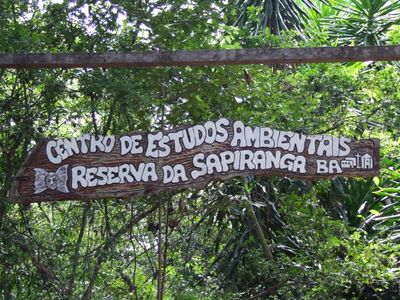
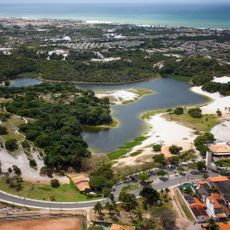
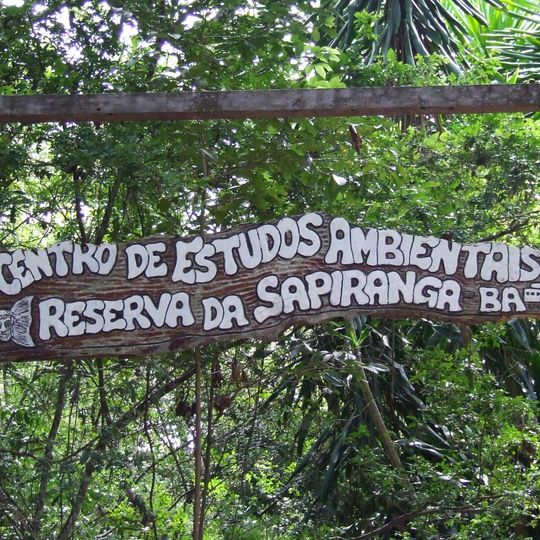
The Sapiranga Reserve covers 600 hectares of secondary Atlantic Forest in Mata de São João, 2 kilometres from Praia do Forte. Three rivers cross it: the Pojuca, good for bathing, the Terebu, which forms the waterfall that draws visitors and feeds a mangrove arm, and the Sapiranga, which rises inside the reserve. Sapiranga and Terebu meet and flow together to the Pojuca, which reaches the Atlantic at Itacimirim beach.
The reserve lies on land that belonged to Garcia d'Ávila's sesmaria, later cleared for cattle and coconut monoculture and turned into a farm called Tapera, after its clay-built houses. German Klaus Peters bought the farm in 1970 and donated the land to the Garcia d'Ávila Foundation, which manages it. State Decree No. 1,046 of 17 March 1992 included it in the Litoral Norte Environmental Protection Area as a strictly protected zone.
The name Sapiranga comes from Tupi: sa (eye) and piranga (red), for the reddish water of the Rio Sapiranga, coloured by high iron content. The reserve belongs to the Garcia d'Ávila Foundation, founded by Klaus Peters, which runs environmental education and scientific research there.
The reserve lies 2 km from Praia do Forte and 80 km from Salvador, reached via the Linha Verde. Three rivers cross it: the Pojuca, calm and good for bathing, the Terebu, whose mouth forms the waterfall, and the Sapiranga, which springs inside the reserve. Trails lead to the cascade and into the recovering secondary Atlantic Forest.
The reserve sits just 22 meters above sea level and works as a travel route for animals that migrate through the region. It also protects many plants and creatures that live nowhere else but in this forest.
The community of curious travelers
AroundUs brings together thousands of curated places, local tips, and hidden gems, enriched daily by 92,813 contributors worldwide.