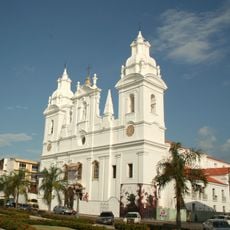
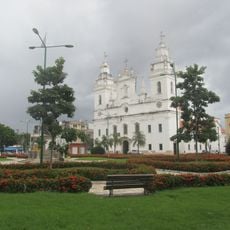
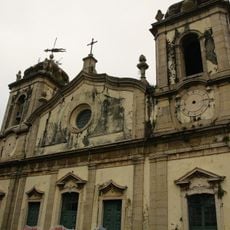
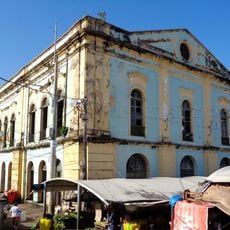
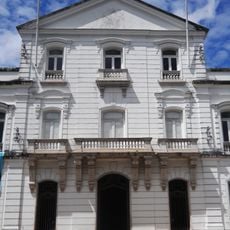
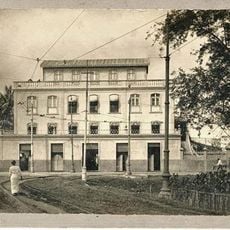
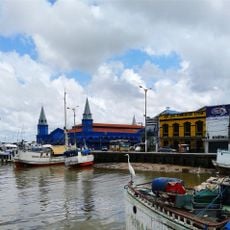
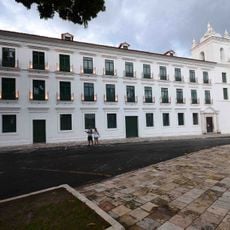
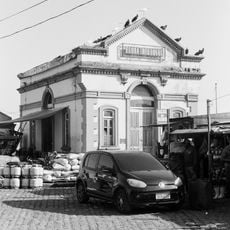
Church of Saint John the Baptist, Portuguese colonial church in Cidade Velha, Belém, Brazil.
The Church of Saint John the Baptist, on Líbano Square in Belém, has a plan of two overlapping squares: the larger forms an irregular octagonal nave, the smaller the main chapel. Its octagonal dome, with slit windows in four panels, is one of few in local architecture. Two altars stand on the nave's wider sides.
The first church on this site was a rammed-earth building with a straw roof, erected in 1622 under captain-major Bento Maciel Parente. It was rebuilt in clay in 1686, became Belém's only parish church in 1714, and served as cathedral from 1721 to 1755, seat of the first three bishops of Pará. The present building, designed by Giuseppe Antonio Landi, was begun in 1772 and completed on 24 June 1777. Spanish Augustinian friars served here from 1899 to 1959; a restoration supervised by architect Elizabeth Soares reopened the church in November 1996.
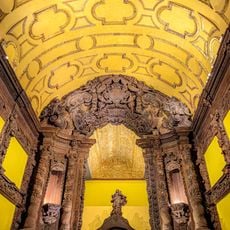
The name São Joãozinho, little Saint John, distinguishes the church from the larger São João Batista. Inside, two canvases by Francisco de Figueiredo, painted in Lisbon in 1774, show the saint's pilgrimage and beheading; a third is lost. The trompe-l'œil paintings imitate pink and green marble and add niches, balustrades and windows that do not exist.
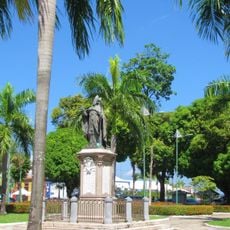
The church stands on Líbano Square, also called Largo de São João, in the Cidade Velha district, near the old cathedral. Its irregular octagonal nave and central dome, one of the few domes in local architecture, make it easy to pick out on foot. The building is protected by IPHAN.
The building features quadratura paintings, a specialized technique from Bologna that creates optical depth through natural light and precise composition. This art form cleverly merges painted architecture with the actual structure of the space.
The community of curious travelers
AroundUs brings together thousands of curated places, local tips, and hidden gems, enriched daily by 92,930 contributors worldwide.