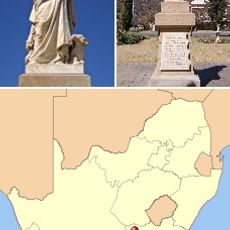
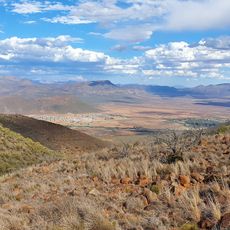
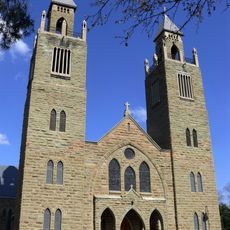
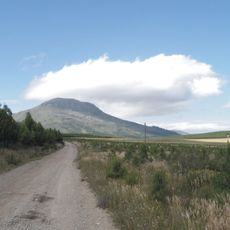
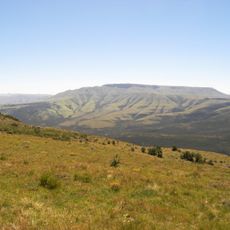
Hofmeyr Skull, Hominin fossil discovery site in Hofmeyr, Eastern Cape, South Africa.
The Hofmeyr Skull is the near-complete cranium of an adult anatomically modern human, found in 1952 on the surface of a dry erosion gully of the Vlekpoort River near Hofmeyr, Eastern Cape. Its lower facial skeleton is damaged, the mandible angle, right mastoid process and much of the occipital are missing, and the third molars are heavily worn. The skull carries a partly healed wound above the left eye.
Discovered in 1952 near the Vlekpoort River, scientific dating revealed the skull to be approximately 36,200 years old. This age determination made the fossil an important find for understanding how modern humans came to be.
The skull's name comes from Hofmeyr, the Eastern Cape town near where it surfaced in a dry bed of the Vlekpoort River. Since 2007 it has been kept at the East London Museum, where it is displayed as Hofmeyr 1. The find site itself is no longer accessible, buried under silt after a weir was built downstream.
The skull is kept at the East London Museum in East London, not in Port Elizabeth. The original find spot near Hofmeyr is no longer accessible: it lies buried under silt after a weir was built downstream on the Vlekpoort River, so the museum is the place to see the specimen.
The skull shows features that differ clearly from the Khoisan peoples who later lived in the region. This suggests that different human groups lived in South Africa at different times.
The community of curious travelers
AroundUs brings together thousands of curated places, local tips, and hidden gems, enriched daily by 94,035 contributors worldwide.