Sibudu Cave, Archaeological rock shelter in KwaZulu-Natal, South Africa.
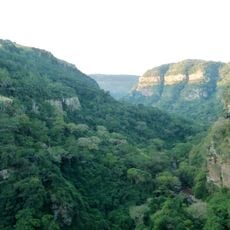
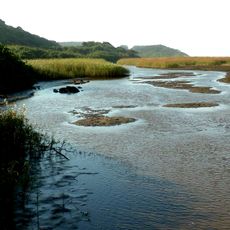
Sibudu Cave is a rock shelter in a steep, forested sandstone cliff facing WSW above the Tongati River, near Tongaat in KwaZulu-Natal. Its floor is 55 m long and about 18 m wide, and the river now runs 10 m below the shelter. The site lies in what is now a sugar cane plantation.
Aron Mazel of the Natal Museum carried out the first excavations after the shelter's discovery in 1983, and Lyn Wadley of the University of the Witwatersrand resumed work in September 1998. Occupation phases run from pre-Still Bay through Still Bay, Howiesons Poort, post-Howiesons Poort, late and final Middle Stone Age, with gaps of about 10,000 years that point to dry spells. An Iron Age occupation followed around 1000 BC, and in 2024 the cave joined the World Heritage Site of Pleistocene Occupation Sites of South Africa.
Visitors see Middle Stone Age layers showing how people developed their tools and adhesives over thousands of years. The finds document the transition to more complex skills through preserved artifacts in the different deposits.
The shelter lies about 40 km north of Durban and roughly 15 km inland, near Tongaat, in a cliff above the Tongati River on land now planted with sugar cane. The river runs about 10 m below the floor, and the floor itself is 55 m long and 18 m wide.
Sibudu also yielded the earliest known bone arrowhead, a point dated to 61,000 years ago that pushed back the origin of bow-and-arrow technology by at least 20,000 years. The same deposits held shell beads and a milk-and-ochre paint mixture 49,000 years old.
The community of curious travelers
AroundUs brings together thousands of curated places, local tips, and hidden gems, enriched daily by 93,010 contributors worldwide.