Ambohimanga, Royal archaeological site in Antananarivo Province, Madagascar
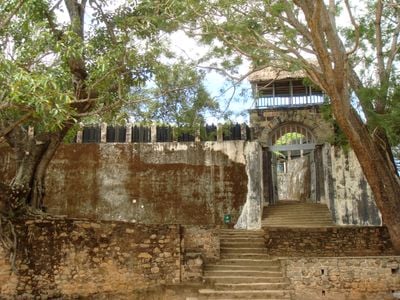
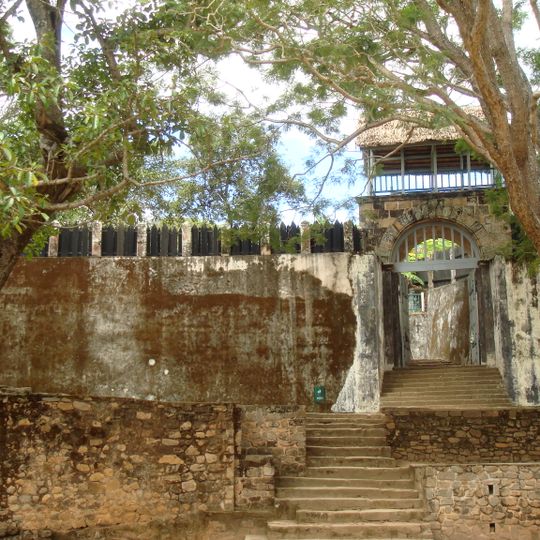
Ambohimanga is a fortified royal hill settlement (rova) about 24 km northeast of Antananarivo. Its hilltop compound is ringed by defensive ditches and stone walls and entered through 14 gateways, several sealed with stone discs. Inside, the Mahandrihono compound, established between 1710 and 1730 by King Andriambelomasina, holds the royal tombs, King Andrianampoinimerina's house and Queen Ranavalona II's summer palace. The photograph shows an ochre-brown wall topped with wooden palisade posts, a stone arch with a wooden balcony under thatch, and stone steps climbing between them.
The hill was settled by the Merina in the 15th century, and around 1700 the dethroned prince Andriamborona was the first to settle on the summit with his family. In the early 18th century King Andriamasinavalona made Ambohimanga the capital of the Avaradrano quadrant, and 77 years of civil war followed. King Andrianampoinimerina ended the war from here and reunited Imerina by 1793, then made the hill the kingdom's spiritual capital. Royal rituals continued until the royal family was exiled in 1897.
The name combines the Malagasy ambohi ("hill") and manga ("sacred", "blue" or "beautiful"); the hill was first called Tsimadilo, then Ambohitrakanga ("hill of the guinea fowls") around 1700, before King Andriamasinavalona gave it its present name. Pilgrims still come from Madagascar and elsewhere, and the tombs of at least four Vazimba — Ingorikelisahiloza, Andriantsidonina, Ramomba and Kotosarotra — are visited on or around the hill.
The hill lies about 24 km northeast of Antananarivo via the RN3, in the commune of Ambohimanga Rova. The royal compound is reached on foot, with stone steps climbing between the ochre-brown wall and the arched gateway toward the upper level. The site is still a place of worship and pilgrimage, so visitors should dress and behave accordingly in the sacred areas.
The royal compound is reached through 14 gateways, several of them sealed with stone disc barriers rather than doors. The layout follows two overlaid cosmological systems that give sacred weight to the northeast, so the gates and buildings are oriented around a unifying centre.
The community of curious travelers
AroundUs brings together thousands of curated places, local tips, and hidden gems, enriched daily by 93,114 contributors worldwide.