Doigt de Sainte-Anne, Volcanic plug in Gallieni Peninsula, Kerguelen Islands, France
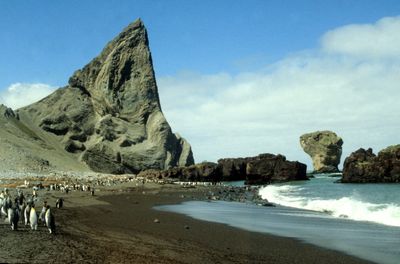
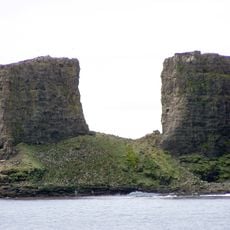
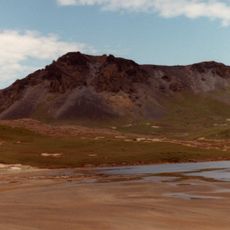
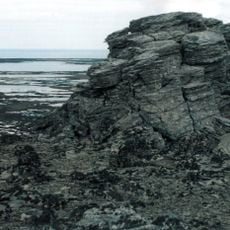
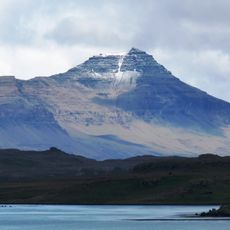
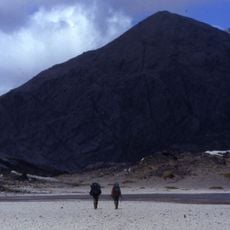
The Doigt de Sainte-Anne is a 235-metre volcanic plug on the western coast of the Gallieni Peninsula, overlooking Larose Bay. It rises from a black sand shore as a steep grey-green mass with a jagged, pointed summit and a broad, sloping base. Deep vertical and diagonal fissures and ridges run up its face; the left side shows smoother sloping buttresses, while the right drops more steeply and narrowly. Near the bottom the rock flares outward into lower, layered ledges.
The formation received its name in 1908 from explorer Raymond Rallier du Baty, replacing an earlier designation on historical maps. This renaming was part of French efforts to establish official geographic nomenclature for the remote island region.
The name comes from Raymond Rallier du Baty, who in 1908 and 1913 likened the isolated rock to the menhirs and isolated eminences his native Brittany calls Sainte-Anne. Earlier charts by the Bossière brothers' Société des îles Kerguelen labelled it Pain de Sucre until 1911. The name entered his 1922 map of the archipelago.
Access requires permission from French authorities and travel by specially equipped vessels designed for Southern Ocean conditions. Visitors should expect extreme weather and limited accessibility windows due to the remote location.
Before 1911, maps of the Bossière brothers' Société des îles Kerguelen labelled the rock Pain de Sucre (Sugarloaf). Raymond Rallier du Baty gave it its present name on his 1908 and 1913 voyages, after the isolated menhirs and eminences called Sainte-Anne in his native Brittany.
The community of curious travelers
AroundUs brings together thousands of curated places, local tips, and hidden gems, enriched daily by 94,444 contributors worldwide.