Pasir Awi inscription, Stone inscription in Sukamakmur, Bogor, Indonesia
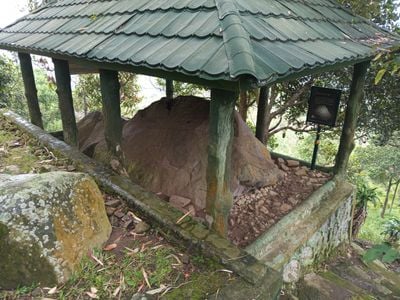
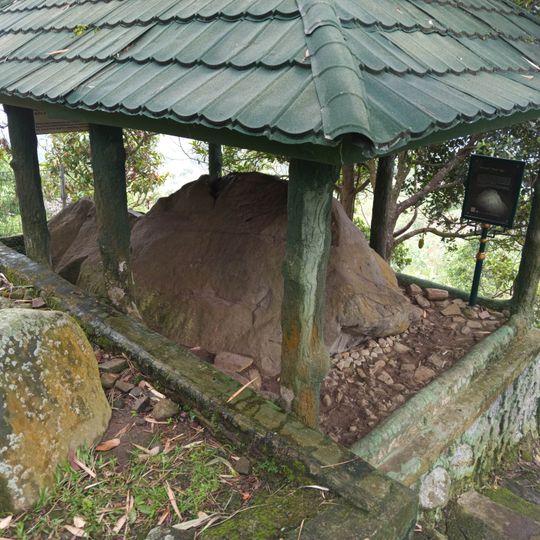
The Pasir Awi is a stone inscription set on a steep slope in the Cipamingkis forest area near Sukamakmur in West Java. The large stone carries footprints and pictographs showing branches, leaves and fruits on its surface.
The Pasir Awi inscription was first found in 1864 by N.W. Hoepermans and reported in 1867 as the Ciampea inscription. It is attributed to the Tarumanagara kingdom of West Java. The script, written in curled letters, remains unreadable, so its date is not fixed by its text.
The carvings pair a pair of footprints, oriented north and east, with pictographs of branches, leaves and fruits rather than letters. The script remains unreadable, so the images carry the message. Standing exactly on the footprints gives a steady footing despite the steep slope below.
The inscription sits on the southern slope of Pasir Awi hill, about 559 metres above sea level, in the Cipamingkis hills forest of Sukamakmur. The carved footprints face north-east, toward steep, dangerous valleys. The stone lies under a green tiled roof on wooden posts, with a low mossy stone border in front. A dark sign stands to its right.
The stone inscription shows curled letters that remain undeciphered to this day and continue to puzzle researchers. Multiple attempts over the decades have brought no clarity about the content of the message from ancient times.
The community of curious travelers
AroundUs brings together thousands of curated places, local tips, and hidden gems, enriched daily by 93,182 contributors worldwide.