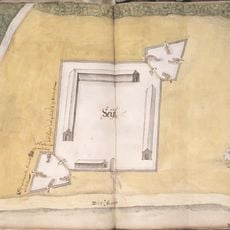
Fort Amsterdam, Dutch colonial fort in Hila, Indonesia.
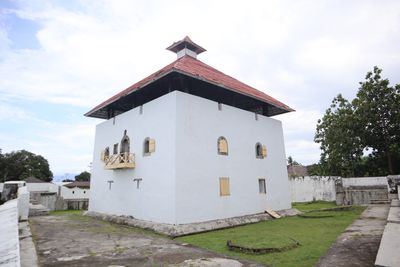
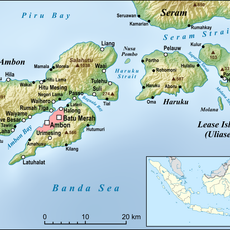
Fort Amsterdam is a colonial-era stone and brick fortification in Hila, on the island of Ambon in Indonesia. It stands three stories tall with a square layout and thick outer walls built to control the surrounding area.
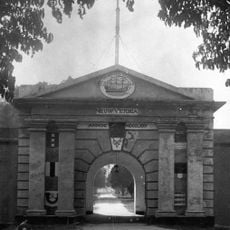
A Portuguese trade lodge was established here in 1512 by Francisco Serrão, cousin of Ferdinand Magellan. After the Dutch took Ambon in 1605, Governor-General Jaan Ottens converted the lodge into a defensive post in 1637 during the uprising led by Kapitan Kakialy. Gerrard Demmer enlarged it in 1642, Anthony Caan continued work in 1649, and Arnold de Vlaming van Oudsthoorn completed it between 1649 and 1656, naming it Fort Amsterdam.
The botanist Georg Rumphius lived and worked within these walls in the late 1600s, studying the plants of the surrounding region. This gives the fort a dual identity as both a military post and an early center of natural science.
The main entrance is in the eastern wall, with additional open passages on the north and south sides. Sturdy shoes are a good idea since the floors can be uneven and some parts of the building are harder to reach.
The restoration begun in July 1991 relied on a drawing by François Valentijn in his Beschreiving van Amboinan, so the present red roof and cupola follow a historical image rather than surviving original fabric. The Dutch had abandoned the blockhouse early in the 20th century, and a large beringin fig had grown around it before the Department of Education and Culture intervened.
The community of curious travelers
AroundUs brings together thousands of curated places, local tips, and hidden gems, enriched daily by 94,125 contributors worldwide.