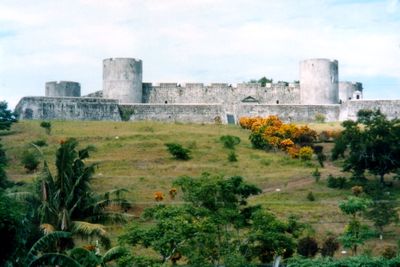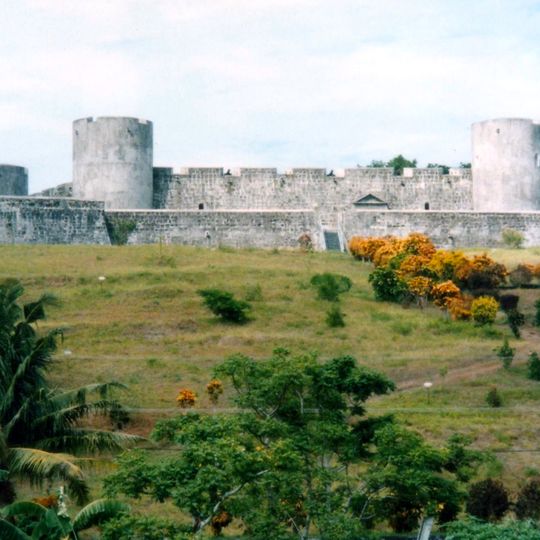
Fort Belgica, Dutch colonial fort in Banda Neira, Indonesia.
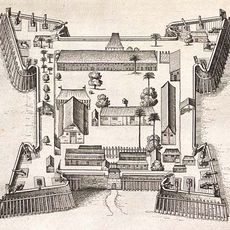
Fort Belgica is a pentagonal stone fort on a hilltop, with a low outer ring of five angled bastions and a higher inner pentagon whose five corners carry tall circular towers. A single stair on the southern outer wall leads to the entrance; inside, rooms surround a pentagonal courtyard, and the outer walls measure about 40 m per side and 5.4 m high.
Pieter Both ordered a fort on the hill above Fort Nassau on 4 September 1611; it was named Belgica. In 1667 Cornelis Speelman had engineer Adriaan de Leeuw redesign it, and the pentagonal castle was built from 1672 to 1673 at a cost of over 300,000 guilders. It surrendered to a British fleet in 1796 without a shot, was stormed by Captain Christopher Cole in 1810, partly demolished in 1904, rebuilt in 1919 and restored from 1991.
The fort's name comes from the Belgen people of Rhun Island, whom the Dutch regarded as free men. In 1803 a military band played at 5 a.m. and 8 p.m. whenever a ship anchored, and guard changes at both Belgica and Nassau drew crowds almost hourly.
Access involves climbing to the hilltop where the fort sits, which requires moderate effort and sturdy footwear due to the slope and stone steps. Morning or late afternoon visits are more comfortable since the exposed hilltop receives strong direct sun during midday hours.
The fort's name comes from the Belgen people of Rhun Island, whom the Dutch regarded as free men. The five outer bastions carry names: Galge punt, Moorsche punt, Leugenaar punt, Metaale punt and Klokke punt, each with a bartizan. The inner pentagon's towers rise 13.8 metres, while the outer wall stands 5.4 metres high.
The community of curious travelers
AroundUs brings together thousands of curated places, local tips, and hidden gems, enriched daily by 93,359 contributors worldwide.