Fort Duurstede, Dutch colonial fortification in Saparua, Indonesia
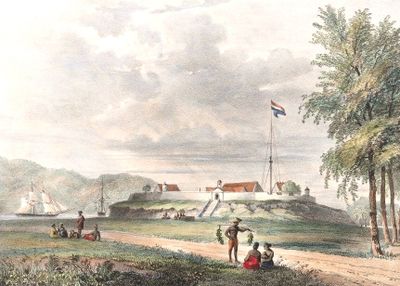
Fort Duurstede is a white-walled fortification on a low grassy rise in Saparua. Its walls form a roughly rectangular enclosure with a low parapet, and inside stand several buildings with red tiled roofs. A white gatehouse with a small roof and a descending staircase sits at the centre of the front wall, while a tall mast with a red, white and blue flag rises to the right.
The site was built in 1691 by the Dutch after they replaced an earlier Portuguese structure. In 1817 it became the center of Thomas Matulessy's rebellion, who fought here against colonial rule under his title Pattimura.
The name Duurstede comes from a Dutch city on the Rhine and was chosen here as a symbol of colonial authority. Today the site stands open to visitors and is frequented by school groups from the region who come to learn about the history of the spice islands.
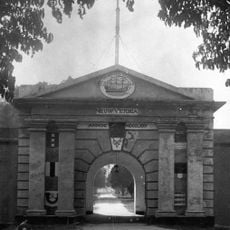
The fort stands on a low grassy rise above Saparoea village, reached by a stone staircase that climbs the slope to a gateway with a triangular pediment. The ground inside the enclosure is uneven, so sturdy shoes help. A navigation guide of 1878 noted good anchorage near the fort in the westerly monsoon, in about 12 fathoms.
The fort's only survivor of the 1817 assault was Jean Lubbert van den Berg, the resident's son. The Dutch retook Saparua only after Rear Admiral Buyskes arrived on 30 September 1817 with the warship Prins Frederik, carrying 40 heavy cannons and 410 personnel. Pattimura and his four commanders were later hanged at Fort Nieuw Victoria.
The community of curious travelers
AroundUs brings together thousands of curated places, local tips, and hidden gems, enriched daily by 93,360 contributors worldwide.