Cape Palliser Lighthouse, Maritime lighthouse at Cape Palliser, New Zealand
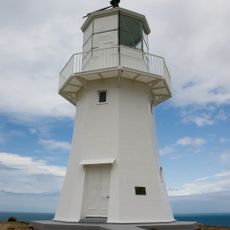
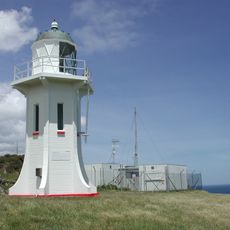
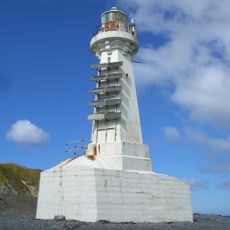
Cape Palliser Lighthouse is a white cylindrical tower with two red bands standing 18 meters high on a volcanic cliff, guiding ships through Pacific waters. The cast iron construction is sturdy and built to withstand the exposed coastal conditions.
The cast-iron tower was built in 1897 and lit with an oil lamp on 27 October that year. Keepers were supplied by sea every three months, and in rough weather goods were landed at Kawakawa Bay, 6 km away. The tower was electrified in 1954, connected to the mains in 1967 with a diesel generator kept for emergencies, and fully automated in 1986.
Supplies for the keepers arrived by sea every three months, a difficult landing on the rocky coast that often cost goods; in rough weather they were unloaded at Kawakawa Bay, 6 km away. The keepers' house and store sheds stood at the coast, so unlike other New Zealand lights nothing had to be hauled up on rail wagons. Fuel was raised up the cliffs with a hand winch.
The lighthouse base is reached by a staircase of 258 steps up a 58-metre cliff; the staircase was built in 1912 and replaced a dangerous dirt track. The site is exposed and the steps can be slippery, so sturdy footwear is recommended. Fuel was once hauled up the cliffs with a hand winch.
Cape Palliser is one of only three New Zealand lighthouses painted in stripes; the others are Dog Island and Cape Campbell, both in black and white. Its red and white rings therefore mark it out among the country's towers, which are otherwise plain.
The community of curious travelers
AroundUs brings together thousands of curated places, local tips, and hidden gems, enriched daily by 94,674 contributors worldwide.