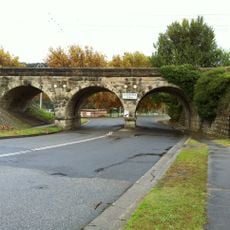
Coxs River railway bridges, Wallerangang, Stone arch railway bridge in Wallerawang, New South Wales, Australia
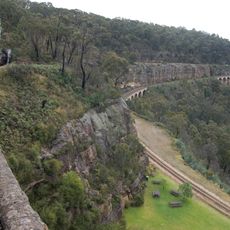
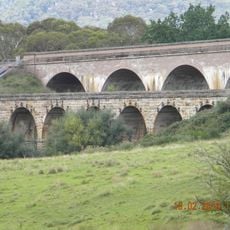
The Coxs River railway bridges comprise an 1870 sandstone viaduct of seventeen stone arch spans totalling 139.6 metres, plus a 1923 brick double-track underbridge. The main span of 16.5 metres has an unusual elliptical arch rib, flanked by stone buttresses rising above the deck, and the radial joints of the rib extend out to fill the whole spandrel.
These bridges were designed by New South Wales Government Railways engineers in 1870 as part of expanding rail lines westward. They represent an early phase of building major infrastructure for the growing railway network.
The 1870 bridge is linked to John Whitton, the "father of New South Wales railways", who turned to stone arch viaducts when funds for wrought iron girder bridges were refused. Its spandrels are unusual: the radial joints of the elliptical arch rib run outward to fill the whole spandrel space, a detail a visitor can trace in the stonework.
The bridges remain active parts of the Main Western Line with regular freight and passenger train service. You can view the structure from ground level and nearby riverside vantage points along the route.
The 16.5-metre main span was the fifth longest masonry arch of its type in 1870, and its arch rib is elliptical rather than the usual circular curve. The radial joints of that rib continue outward to fill the whole spandrel, a detail visible from below.
The community of curious travelers
AroundUs brings together thousands of curated places, local tips, and hidden gems, enriched daily by 94,672 contributors worldwide.