Old Como railway bridge, Heritage railway bridge in Como, Australia
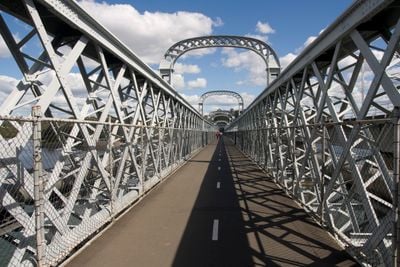
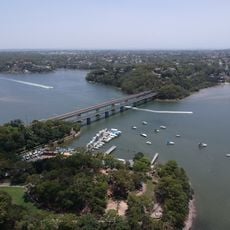
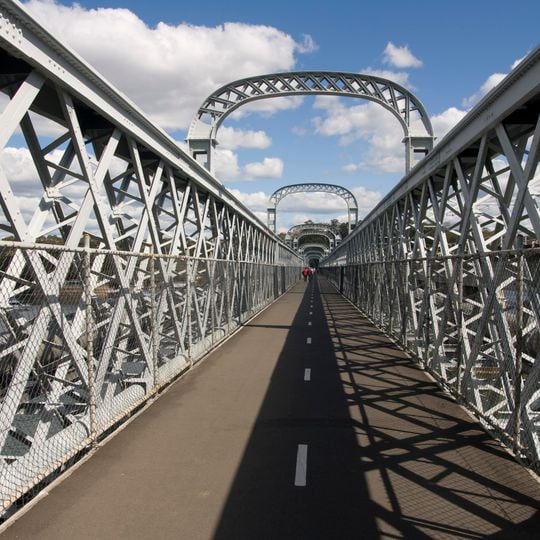
The Old Como railway bridge is a single-track steel lattice girder bridge over the Georges River between Como and Oatley, designed by John Whitton and built 1883–1885 by C. and E. Millar. Its deck now carries a bitumen footway and cycleway, with a 1,220 mm water main split into two 600 mm mains on steel outriggers along the sides. Two arched steel spans rise overhead, and wire mesh fencing lines the inner girders.
Designed by John Whitton and the Department of Railways, the bridge was built from 1883 to 1885 by C. and E. Millar as part of the original Illawarra railway line. Within five years the single track became a bottleneck once double track was laid on either side, and the lines converged into a gauntlet track across the bridge. It was superseded in 1972 by a new double-track concrete bridge alongside, and its deck was converted to a cycleway and footpath in 1985.
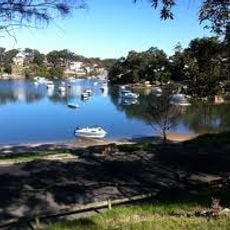
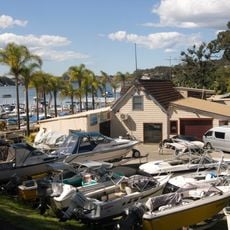
The railway's arrival in the 1880s drew Sydney day-trippers to the Como boatsheds, baths, fishing spots and the nearby national park. Since 1985 the deck has served as a cycleway and footpath between Como and Oatley, opened a century after the bridge was built.
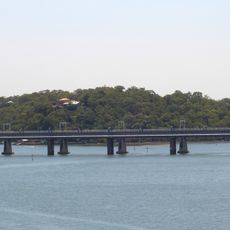
The deck is a bitumen footway with a broken white centre line, reached from Como and from Oatley; the 1985 conversion removed the rail infrastructure and timber walkway planks beside the pipeline. Wire mesh fencing lines both sides at railing height, and the water mains run on outriggers outside the girders, so keep to the paved centre. The old bridge stands beside the 1972 concrete railway bridge.
Within five years of opening, the single track became a bottleneck once double track was laid on both approaches. The two tracks converged into a single gauntlet track across the bridge, letting trains pass in either direction without points; it was one of only a few such installations in NSW.
The community of curious travelers
AroundUs brings together thousands of curated places, local tips, and hidden gems, enriched daily by 94,142 contributors worldwide.