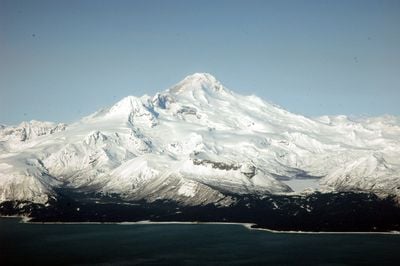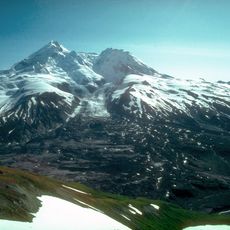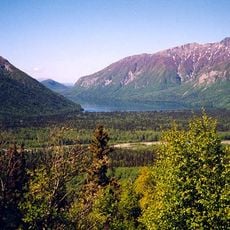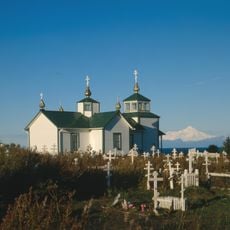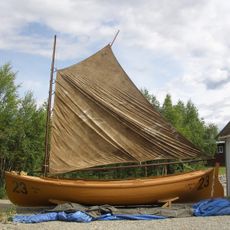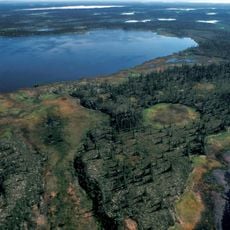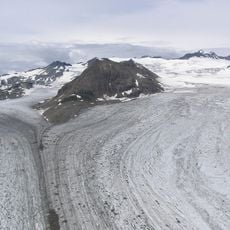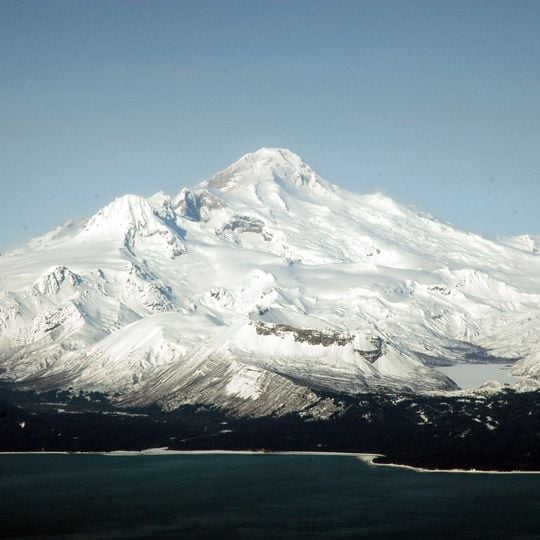
Mount Iliamna, Stratovolcano in Lake Clark National Park, Alaska.
Mount Iliamna is a glacier-covered stratovolcano rising 3,053 m on the west side of lower Cook Inlet in Lake Clark National Park and Preserve. Glaciers have cut deep cliffs and cirques into its cone, and a ridge runs 5 km south to the North Twin and South Twin peaks. A dark rocky band crosses its lower slopes above the forested shore.
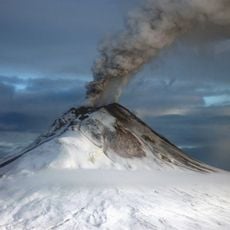
Iliamna's recorded eruptions occurred in 1867 (VEI-2) and 1876 (VEI-3), with unconfirmed activity reported in 1933, 1947, 1952 and 1953. Radiocarbon dating points to prehistoric eruptions around 5050 and 2050 BCE, 450 BCE and 1650. The first ascent was made in 1959, and the volcano was designated a National Natural Landmark in 1976.
Local indigenous peoples call this volcano Ch'naqał'in in Dena'ina and Puyulek in Sugpiaq, names that have been passed down through generations. These different names show how central this mountain has been to the region's native communities for a very long time.
The volcano rises on the west side of lower Cook Inlet, about 215 km southwest of Anchorage, inside Lake Clark National Park and Preserve. It is seen from across the water and from the air; the summit was first climbed only in 1959. Steam plumes from the eastern flank fumaroles are often mistaken for eruptions.
Iliamna has no summit crater: fumaroles sit just south of the top, at the head of a large collapse zone above Red Glacier that exposes a cross section of the mountain's interior. The vents, at about 2,740 m on the eastern flank, release nearly constant steam and minor sulfurous gases, vigorous enough to prompt repeated pilot reports of "eruptions".
The community of curious travelers
AroundUs brings together thousands of curated places, local tips, and hidden gems, enriched daily by 93,699 contributors worldwide.