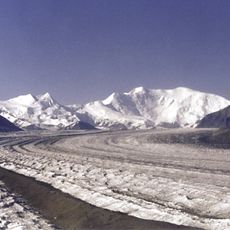
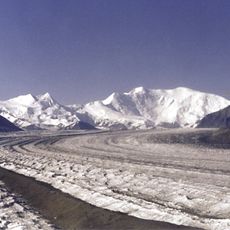
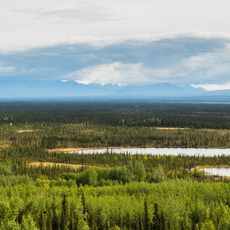
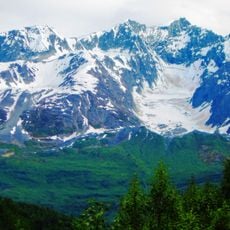
Mount Sanford, Volcanic mountain in Wrangell Range, Alaska, United States.
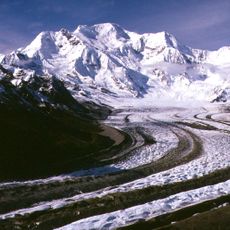
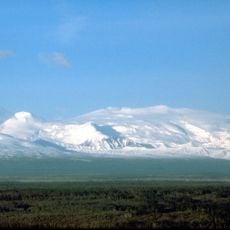
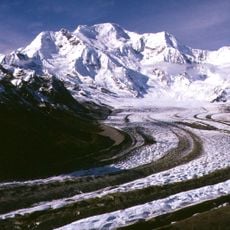
Mount Sanford is a shield volcano in the Wrangell Volcanic Field of eastern Alaska, near the Copper River, reaching 4,949 metres. It is built mainly of andesite, and its upper 600 metres appear to be a lava dome filling a summit crater. The south face above Sanford Glacier rises 2,400 metres in 1,600 metres, one of the steepest gradients in North America.
The volcano last erupted roughly 320,000 years ago, long before recorded human activity in the region. The first documented summit attempt was made in 1938 when climbers explored the northern approach via Sheep Glacier.
The mountain's name comes from Lieutenant Henry T. Allen of the U.S. Army, who named it in 1885 after his ancestor Reuben Sanford, an American politician. The first solo ascent was made on September 19, 1968 by Japanese mountaineer Naomi Uemura, who later died shortly after completing the first solo winter ascent of Denali.
The mountain is accessible only to experienced climbers with specialized mountaineering equipment, using the northern Sheep Glacier route as the standard approach. The climb demands careful preparation for extreme alpine conditions and should not be undertaken lightly.
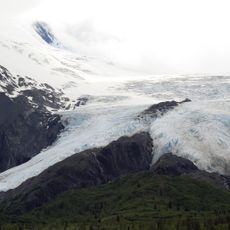
The summit's top 2,000 feet (610 m) are thought to be a lava dome filling a larger crater, hidden beneath the icefields. The largest glacier, the Sanford Glacier, starts at the steep cirque cut into the south side. Reported vapor clouds and plumes often turn out to be ice and rockfalls, or orographic clouds.
The community of curious travelers
AroundUs brings together thousands of curated places, local tips, and hidden gems, enriched daily by 92,922 contributors worldwide.