Mount Wrangell, Shield volcano in Wrangell-St. Elias National Park, Alaska, United States
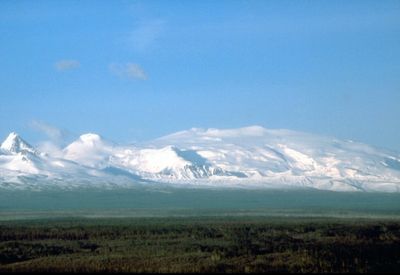
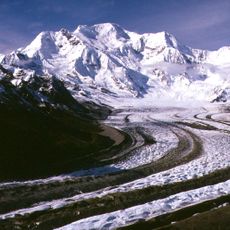
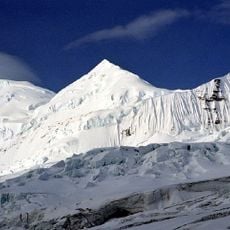
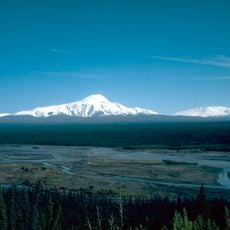
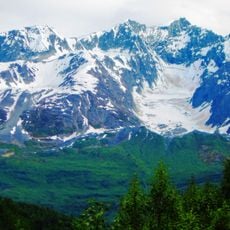
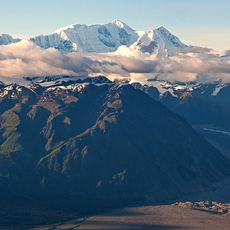
Mount Wrangell is a shield volcano in Wrangell-St. Elias National Park, Alaska, built mainly of andesite rather than basalt. Its ice-filled summit caldera, 4 by 6 km, is rimmed by three craters with fumarolic steam plumes. The west summit reaches 4,271 m, and the 3,965 m Mount Zanetti cinder cone rises from the northwest flank.
Mount Wrangell is a shield volcano built on the remnants of a mid-Pleistocene edifice, with eruptive activity spanning from about 750,000 years ago. Its bulk formed through large lava flows between 600,000 and 200,000 years ago, and the summit caldera likely collapsed within the last 200,000 years. The only historically recorded eruptions in the Wrangell Volcanic Field were small steam and ash explosions reported in 1784 and 1884–85, the latter by prospector Jon Bremner; an 1890 report noted a visible glow, and activity in March and April 1930 was first attributed to Mount Blackburn.
The Ahtna name K'ełt'aeni means "the one who controls the weather"; when the volcano is active they call it Uk'ełedi, "the one with smoke on it". Pre-1900 maps label the peak Mount Tillman, and the mountain is named after Russian admiral Ferdinand von Wrangel, governor of Russian America from 1830 to 1836.
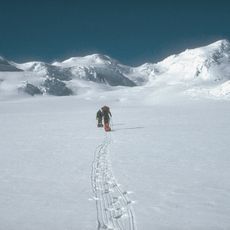
The summit can be reached by ski-equipped airplane, the usual way climbers arrive; Wrangell was the first high volcano in its range to be climbed. Above 4,000 m the summit region spans roughly 3 by 8 km, so parties should plan for crevassed ice and steam plumes from the rim craters.
Mount Wrangell is built mainly of andesite, a rock typical of stratovolcanoes, yet it forms a shield volcano; how this happened is poorly understood. Its summit can be reached by ski-equipped airplane, and the north crater once held small lakes formed by melted ice.
The community of curious travelers
AroundUs brings together thousands of curated places, local tips, and hidden gems, enriched daily by 94,225 contributors worldwide.