Gulkana Glacier, Valley glacier in Alaska Range, United States.
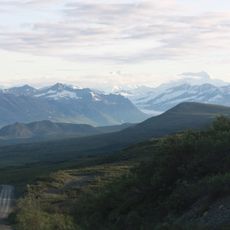
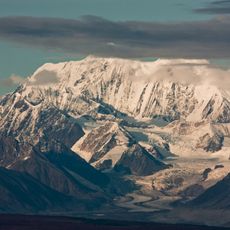
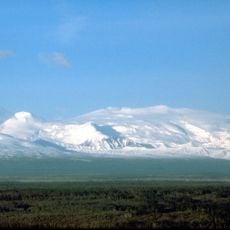
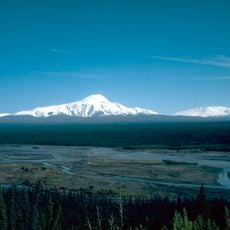
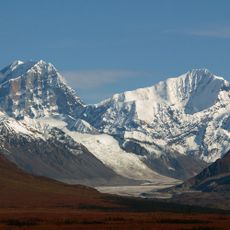
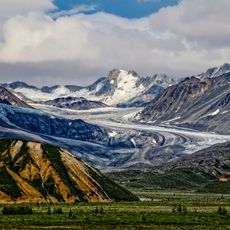
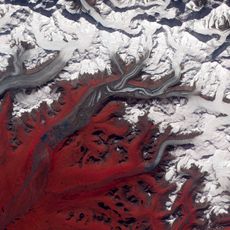
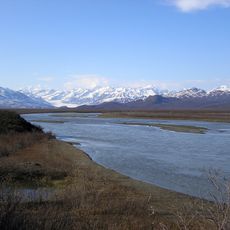
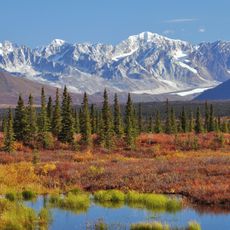
Gulkana Glacier is a valley glacier flowing from the southern edge of the eastern Alaska Range, composed of a large mass of ice framed by surrounding mountain peaks. The ice field descends through a broad valley, displaying the typical ridged patterns and features of a working glacier system.
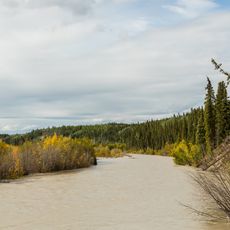
The USGS began annual mass-balance measurements at Gulkana Glacier in 1966, making it one of three long-term reference glaciers monitored alongside Wolverine and South Cascade glaciers. Since then the glacier has lost an average of 0.4 metres of mass per year, and its ice flow has slowed, causing retreat. A stream gauge on Phelan Creek stands at 1,125 metres, one kilometre downstream of the 1996 terminus.
Gulkana Glacier is one of three benchmark glaciers the USGS monitors long-term, alongside Wolverine and South Cascade glaciers. Each spring the Arctic Man competition, a ski and snowmobile race, is held near the glacier. A hill southwest of the ice carries a post labelled PEWE 1975.
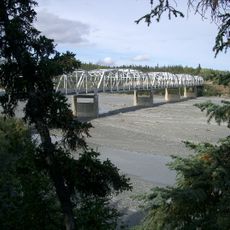
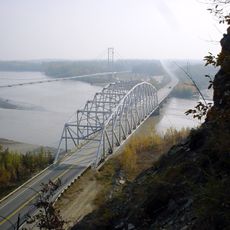
Access is via gravel roads off the Richardson Highway near mile post 197 at the Richardson Monument, about two miles north of Summit Lake and 12 miles north of Paxson; the glacier front lies roughly ten kilometres from the road. A suspension bridge lets pedestrians cross Phelan Creek. Moose and bears live in the area, and the Arctic Man competition is held nearby each spring.
The glacier exhibits noticeable seasonal shifts in thickness and extent, with its surface clearly retreating during warmer months. These fluctuations are directly observable to visitors and provide a firsthand view of how ice masses respond to yearly cycles.
The community of curious travelers
AroundUs brings together thousands of curated places, local tips, and hidden gems, enriched daily by 94,005 contributors worldwide.