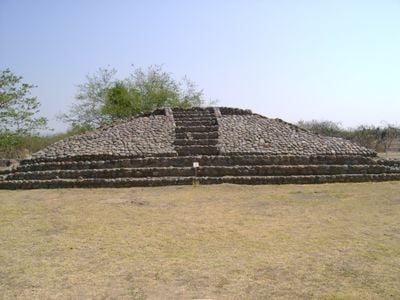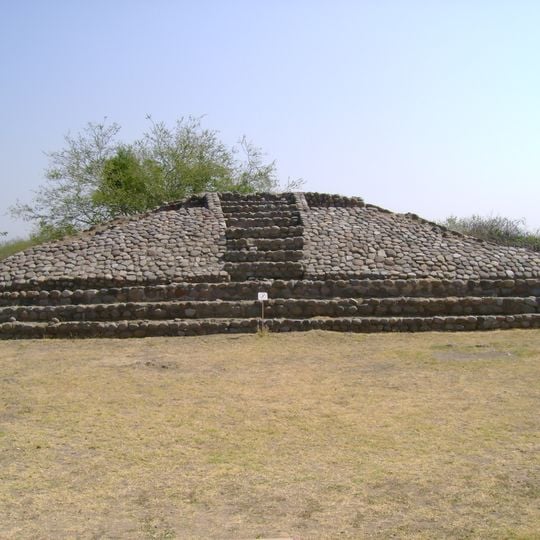
La Campana, Archaeological complex in Villa de Álvarez, Mexico.
La Campana is an archaeological complex near Colima with pyramid-shaped structures, residential areas, ball courts, and underground chambers organized across a large planned layout. The site displays a deliberate arrangement of different functional zones that worked together as an urban center.
La Campana began as a Capacha-phase settlement around 1500 BCE and by the Classic period (200–900 CE) had become the largest pre-Hispanic population center in western Mexico, with its peak between 700 and 900 CE. The Spaniards reached the site in 1524, when it was known as Almoloyan. Formal recognition came in 1917 through engineer José María Gutiérrez, who mapped some structures; Dr. Miguel Galindo Velasco began excavating a building in 1922.
The site's original name was Almoloya, and the Spaniards who reached it in 1524 recorded it as Almoloyan, meaning a place of springs. Its residents spoke Nahuatl and also Uto-Aztecan languages such as Cora, Huichol and Tepehuán. Shaft tombs and ceramic offerings found here belong to the Capacha phase, dated to around 1500 BCE.
The site is located north of Colima and reachable by public transportation or taxi from the city. Visitors should check local conditions and access requirements before planning their trip to ensure smooth entry.
The complex features a sophisticated system for draining rainwater that reveals how advanced urban planning was at the time. Buildings were deliberately constructed with materials selected to withstand earthquakes.
The community of curious travelers
AroundUs brings together thousands of curated places, local tips, and hidden gems, enriched daily by 94,227 contributors worldwide.