Agave Landscape and Ancient Industrial Facilities of Tequila, Agricultural heritage site in Jalisco, Mexico.
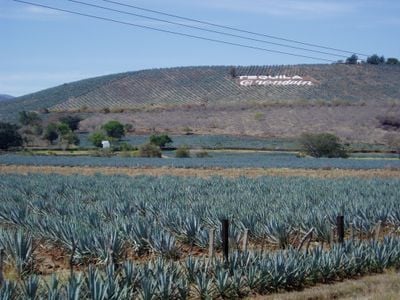
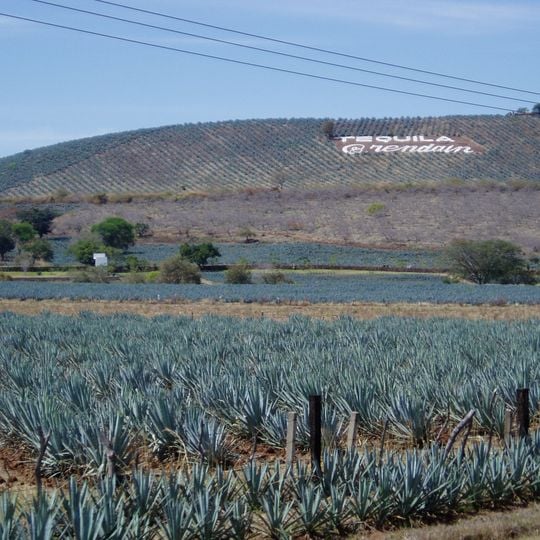
The Agave Landscape and Ancient Industrial Facilities of Tequila is a UNESCO World Heritage Site of 35,019 hectares between the Tequila volcano and the Grande de Santiago river valley. It covers working blue agave fields and the towns of Tequila, Magdalena, El Arenal and Amatitán, with distilleries where the agave "piña" is fermented and distilled. In the photograph, rows of blue-green agave climb a hillside where white letters spell "TEQUILA" above the cursive word "Cuervain".
Agave cultivation for tequila began in the 16th century, while fermented beverage and textile production in the region goes back over two millennia. This long history shaped the current landscape and production methods.
Agave has been used here for at least two millennia, first for fermented drinks such as pulque and for cloth, and since the 16th century for tequila. The working distilleries in Tequila, Magdalena, El Arenal and Amatitán grew with 19th- and 20th-century demand. Today agave culture is treated as part of Mexican national identity, and the landscape has appeared in film, music, dance and painting.
The site covers 35,019 hectares between the Tequila volcano and the Grande de Santiago river valley, with core zones in the Tequila–Amatitán valley and at Los Guachimontones. The towns of Tequila, Magdalena, El Arenal and Amatitán are the main access points, and buses run there from Guadalajara. Distilleries in these towns can be visited; the fields themselves are working farmland, so keep to roads and paths.
Beneath the agricultural landscape lie pre-Columbian structures from the Teuchitlan tradition, including temples, ceremonial grounds, and ball courts. These older settlement patterns show the region was an important center since ancient times.
The community of curious travelers
AroundUs brings together thousands of curated places, local tips, and hidden gems, enriched daily by 92,613 contributors worldwide.