Deep Space Network, Communications network system in Pasadena, US
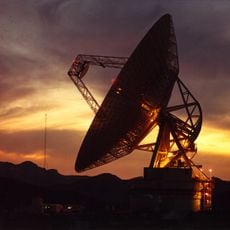
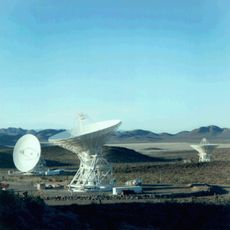
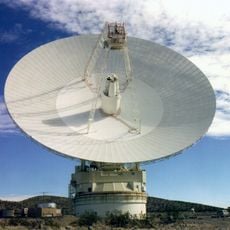
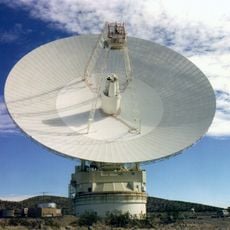
The Deep Space Network is a set of three spacecraft communication complexes: Goldstone in California, Madrid in Spain and Canberra in Australia. Each sits in bowl-shaped, semi-mountainous terrain that shields the antennas from radio interference. The photograph shows one of the large white parabolic dishes, a lattice of small rectangular panels on a steel mount, with a feed assembly held out front on angled struts.
The network's precursor began in January 1958, when JPL used mobile tracking stations in Nigeria, Singapore and California to receive telemetry from Explorer 1. After JPL passed to NASA on 3 December 1958, the agency set up the Deep Space Network as a single system serving all deep-space missions. Two early 26-metre stations, Woomera (1959–1972) and Hartebeesthoek (1961–1974), were later closed.
The network's name comes from its purpose: reaching spacecraft in deep space, which the ITU defines as starting 2 million km from Earth. Its three sites sit near 14° W, 113° W and 149° E, so a probe is handed from one station to the next before it drops below the horizon. The DSN also has a cross-support agreement with ESA's ESTRACK network, and the Parkes radio telescope can be added to the Canberra complex.
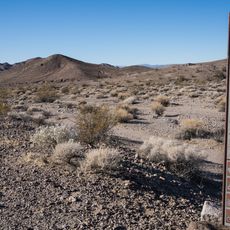
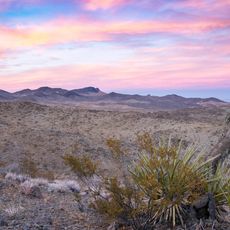
The control rooms are located at the Jet Propulsion Laboratory in Pasadena, where engineers coordinate signals from all three sites. The antennas themselves stand in remote desert areas to minimize interference from radio traffic and urban noise.
The antennas can pick up signals weaker than the tick of a digital watch, even when the spacecraft is billions of kilometers away. Each of the three facilities can communicate with multiple spacecraft at the same time using several antennas.
The community of curious travelers
AroundUs brings together thousands of curated places, local tips, and hidden gems, enriched daily by 92,608 contributors worldwide.