Black Mountain, Mountain summit in Cave Creek, Arizona, United States.
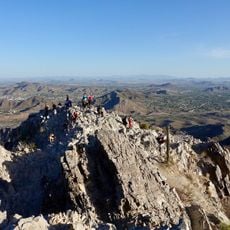
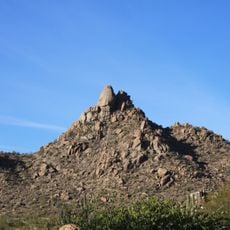
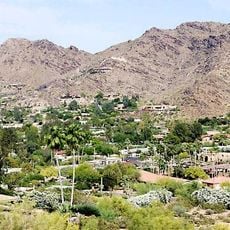
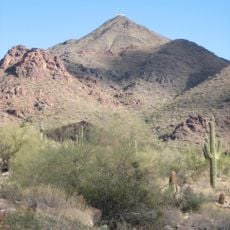
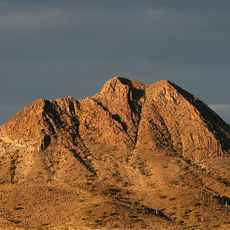
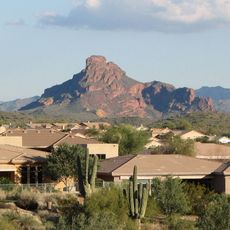
Black Mountain rises 3,398 feet above sea level between Carefree and Cave Creek. Its western half is phyllite and argillite whose dipping beds resemble overlapping flatirons in afternoon light; the eastern half is 14-million-year-old Camelback Granite, weathered into rounded boulders. The two rock types meet in a saddle between a pointed dark peak and a flat-topped granitic one.
The Hohokam lived around Black Mountain from about 750 A.D. until roughly 1450 A.D., leaving pit houses such as those at the Sears-Kay ruin near Seven Springs. From about 1450 to the 1870s Tonto Apache bands controlled the area. After gold was found in the 1870s, Gen. George Stoneman's troops built Military Road, now a main artery of Cave Creek, to protect miners crossing the Desert Foothills.
The area around the mountain was home to the Hohokam from about 750 A.D.; their waffle gardens can still be seen in the Spur Cross Ranch reserve north of Cave Creek, and pit houses have been uncovered during home construction in Cave Creek. From about 1450 to the 1870s Tonto Apache bands controlled the territory. Today Carefree and Cave Creek draw retirees, artists and entrepreneurs.
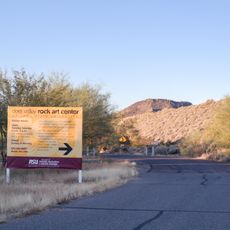
The trailhead is accessed from Schoolhouse Road with free parking available, making the approach straightforward. The best hiking season runs from October through April when temperatures are mild and more comfortable.
The dark rock on the west face is phyllite and argillite, not basalt, though from a distance it is easily mistaken for it; basalt does not occur on Black Mountain. The two peaks, a pointed phyllite summit and a flat-topped granite one, meet at a saddle.
The community of curious travelers
AroundUs brings together thousands of curated places, local tips, and hidden gems, enriched daily by 92,716 contributors worldwide.