Palacio Legislativo de Donceles, Legislative palace in Centro Histórico, Mexico City, Mexico.
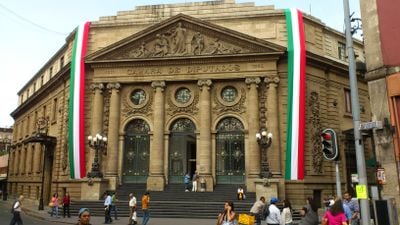
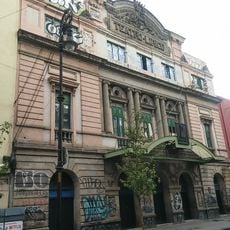
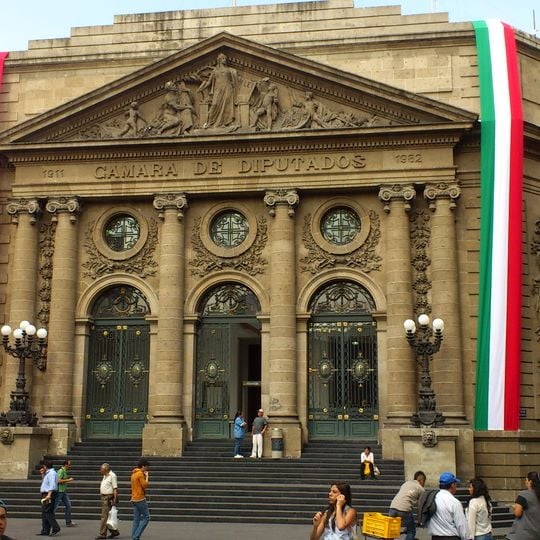
The Palacio Legislativo de Donceles is a neoclassical stone building in Mexico City's historic center. Its light tan facade is symmetrical around three tall arched doorways with dark green metal doors, and three circular windows with carved stone surrounds sit above them. A triangular pediment with relief sculpture crowns the center, and an inscription reads "CAMARA DE DIPUTADOS" with "1911" to its left and "1952" to its right. Wide stone steps lead to the base, and a long green, white, and red vertical banner hangs down the right side.
The building was constructed to house Mexico's legislative power and witnessed key moments such as Porfirio Diaz's resignation in 1911. It remained an important setting for political decisions, including the oil expropriation of 1938 under President Lazaro Cardenas.
The building's facade carries the inscription "CAMARA DE DIPUTADOS" flanked by the dates 1911 and 1952, marking its inauguration and a later remodeling. Since 2018 it has housed the Congress of Mexico City, and it also contains the Legislative Museum and the Institute of Legislative Research, which hold parliamentary meetings and conferences.
The palace stands on Donceles street in the Centro Histórico, a short walk from the Zócalo and near the Hidalgo metro station. It now houses the Instituto de Investigaciones Legislativas and the Museo Legislativo, and hosts academic meetings and congresses on parliamentary questions. It was declared an artistic monument on 30 April 1987.
The 1911 inauguration coincided with Porfirio Díaz's final government report on April 1; weeks later, on May 25, 1911, he resigned the presidency inside this palace. The facade inscription pairs 1911 with 1952, and the building was declared an artistic monument on April 30, 1987.
The community of curious travelers
AroundUs brings together thousands of curated places, local tips, and hidden gems, enriched daily by 93,781 contributors worldwide.