Tlatelolco, archaeological site in Cuauhtémoc, Mexico City, Mexico
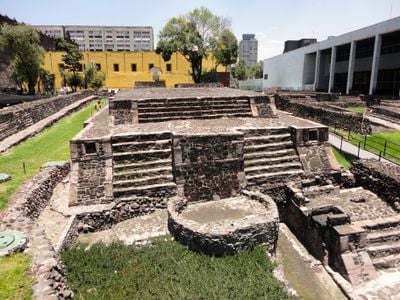
Tlatelolco is an archaeological site centred on the Plaza de las Tres Culturas in Mexico City. Its excavated area holds 67 structures, including the Major Temple, a three-tiered platform with wide stairways split by central and lateral alfardas, and the Calendar Temple, the only minor temple with a double staircase. The visible stonework includes dark volcanic rock set in mortar, pink quarry ashlery in Temples I and J, and a low circular basin near the main stairway.
Founded in 1338, this location grew into a thriving independent city with its own government and trade networks. A military conflict in 1473 brought it under the control of Tenochtitlan, though it remained an important commercial hub for the Aztec empire.
The name Tlatelolco comes from Nahuatl tlāltelol[ol]co, meaning "rounded mound or heap of earth". Its market, the tianguis, was the largest in Mesoamerica and sold goods from distant regions; Hernán Cortés visited it before the conquest war. The Calendar Temple preserves a mural of the deities who created the tonalpohualli, and the Coatepantli, "wall of snakes", framed the road north toward Tepeyac.
The site is walkable with marked paths connecting the various ruins and areas throughout the grounds. Comfortable shoes are recommended since you will be walking on uneven terrain, and bringing water is important as there is limited shade.
In 1963, excavations at the site uncovered a burial of 54 people with their offerings, victims of the 1473 war between Tenochtitlan and Tlatelolco. Among them, a couple found embracing, a man of about 55 and a woman of 35, became known as "The Lovers of Tlatelolco".
The community of curious travelers
AroundUs brings together thousands of curated places, local tips, and hidden gems, enriched daily by 93,799 contributors worldwide.