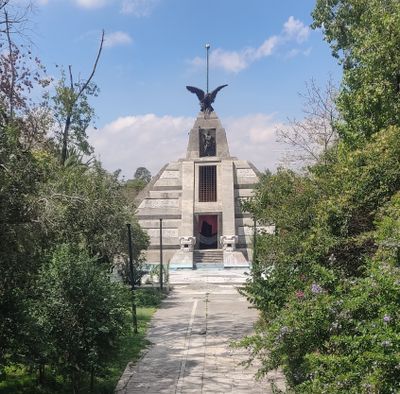
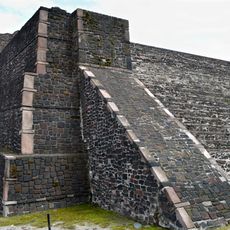
Monumento a La Raza, Pyramidal monument at Insurgentes Norte intersection, Mexico City, Mexico
Monumento a La Raza is a 50-meter concrete pyramid made of three superimposed truncated pyramids at the intersection of Avenida de los Insurgentes, Circuito Interior and Calzada Vallejo. Its sloped walls carry reliefs inspired by the Feathered Serpent of Xochicalco, and two stairways with large serpent heads at their base lead to the upper platform and the entrance. A copper-and-steel eagle with a 5.75-meter wingspan, devouring a snake on a nopal, crowns the top.
Construction began in 1930 on a federal project designed by engineer Francisco Borbolla, with sculptures and layout by architect Luis Lelo de Larrea, advised by Augusto Petriccioli. It was inaugurated on 12 October 1940, the Día de la Raza, and dedicated to Indigenous peoples of the Americas. The eagle on top was cast by Georges Gardet for the never-finished Federal Legislative Palace, whose site became the Monumento a la Revolución.
The name refers to la Raza, the Indigenous peoples of the Americas and their descendants, a term promoted after the Mexican Revolution and later central to the Chicano Movement. The bronze high reliefs by Jesús Fructuoso Contreras depict the tlatoque of the Triple Alliance — Itzcoatl of Tenochtitlan, Nezahualcoyotl of Texcoco, Totoquihuatzin of Tlacopan — plus Cuauhtémoc; replicas stand in the Jardín de la Triple Alianza.
The monument stands at the junction of Avenida de los Insurgentes, Circuito Interior and Calzada Vallejo, and Metro La Raza, whose logo is the monument's silhouette, serves the site. The two stairways start from the base: the south one climbs to the upper platform, the north one leads to the entrance door. The surrounding roads carry constant traffic, so approach on foot from the metro exits.
The eagle at the top was cast by Georges Gardet for the never-finished Federal Legislative Palace planned under Porfirio Díaz; after the Revolution the project was abandoned, and the 5.75-metre copper-and-steel bird, wings spread over a nopal and a 5.30-metre snake, was moved here. Its companion lions by the same sculptor now stand at the entrance to Bosque de Chapultepec.
The community of curious travelers
AroundUs brings together thousands of curated places, local tips, and hidden gems, enriched daily by 94,083 contributors worldwide.