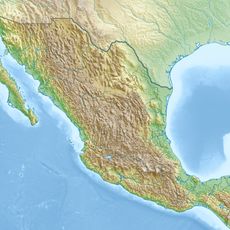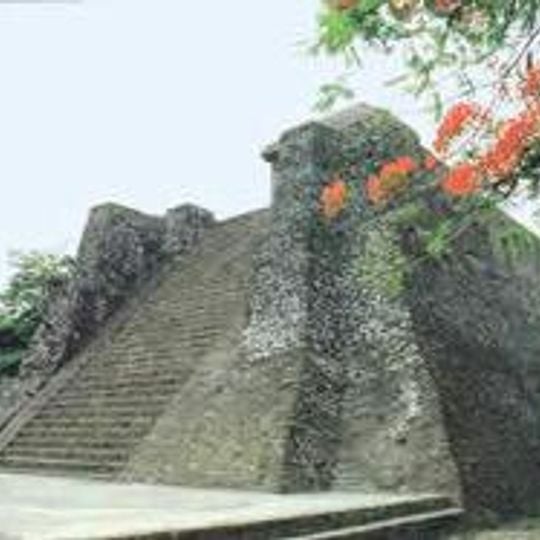
Castillo de Teayo, Pre-Hispanic pyramid in Veracruz, Mexico
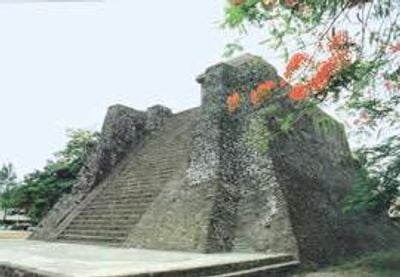
Castillo de Teayo is a Mesoamerican pyramid in Veracruz with three stepped tiers and a central stairway. The structure spans approximately 24 meters on each side of its square base and rises about 11 meters tall.
The site was inhabited between the 10th and 12th centuries by the Huastec culture, and during the Late Postclassic it developed a strong Mexica (Aztec) influence. The surviving pyramid is considered by specialists to have Aztec-style architecture, though the village also had ties to Toltec groups from the Mexican Plateau. It was formerly called Tzapotlán.
The site's name derives from Huastec teayo or teayoc, "on the stone turtle", or Nahuatl Teayok, "turtle on stone"; the Tuxpan Canvas shows the place as the Teayotlán glyph. Sculptures found around the pyramid, now in the small site museum, include figures with a phallic style common in some ancient cultures. The town grew around the pyramid, which gave it and the municipality their name.
An on-site museum displays artifacts and sculptures from excavations, located at the Pyramid Plaza in downtown Teayo. Visiting early in the day helps you explore in cooler conditions and see the stone details more clearly.
The name has two proposed origins: Huastec teayo or teayoc, and Nahuatl Teayok, both rendered as "turtle on stone". The Tuxpan Canvas shows the place as the Teayotlán glyph, a turtle image. The site was formerly called Tzapotlán, and the modern town grew around the pyramid.
The community of curious travelers
AroundUs brings together thousands of curated places, local tips, and hidden gems, enriched daily by 94,309 contributors worldwide.