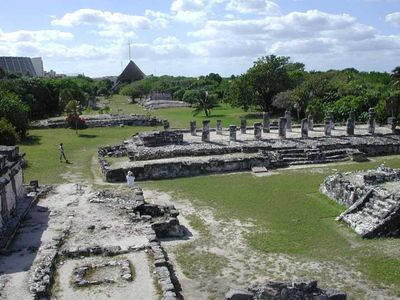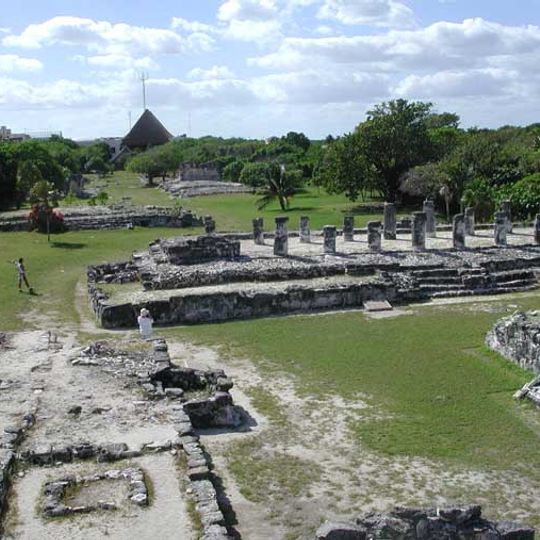
El Rey archaeological site, Mayan archaeological site in Cancun, Mexico.
El Rey is a Maya site on the southern tip of Cancún island, at kilometer 18 of Kukulcán Boulevard. Its 47 structures, built of limestone with plaster or stucco coating, line a main causeway and two small plazas. Building 2 is a pyramidal base with a temple showing at least two construction phases.
El Rey was likely settled from around 300 CE, and its inhabitants lived as fishermen and salt workers between 200 and 1200 CE, trading salt and fish with inland cities. From about 1200 CE, as inland centres declined and coastal trade grew, the village expanded into a port of political and religious weight. Immigrants from the Yucatán interior arrived around 1300–1500 CE and built the structures visible today; after the Spanish arrived the site was gradually emptied and stood abandoned by the mid-16th century.
The name El Rey comes from a sculpture that looked like a monarch; its head is kept in the Cancún Archaeological Museum. Between 200 and 1200 CE, residents fished and extracted salt, trading these goods inland to pay tribute to powerful regional centers. In the late period (1300–1550 CE), immigrants from the Yucatán interior arrived, and the site became a Caribbean coast port within a network that included Xcaret, Xel Há, Tulum, Tankah and Muyil.
The site sits right on a beach and is easily accessible via level walkways connecting the ruins. Bring sun protection since shade is sparse, and wear comfortable shoes to explore the grounds without strain.
The name El Rey comes from a sculpture found at the site that looked like a monarch; its head is kept in the Museo Arqueológico de Cancún. The most important building, Structure 2, is a pyramidal base with a temple showing at least two construction phases. In 1975 excavations there uncovered the burial of a high-ranking person with a copper axe, a bracelet and shell and bone ornaments.
The community of curious travelers
AroundUs brings together thousands of curated places, local tips, and hidden gems, enriched daily by 93,762 contributors worldwide.