Xcaret, Maya archaeological site in Solidaridad, Mexico
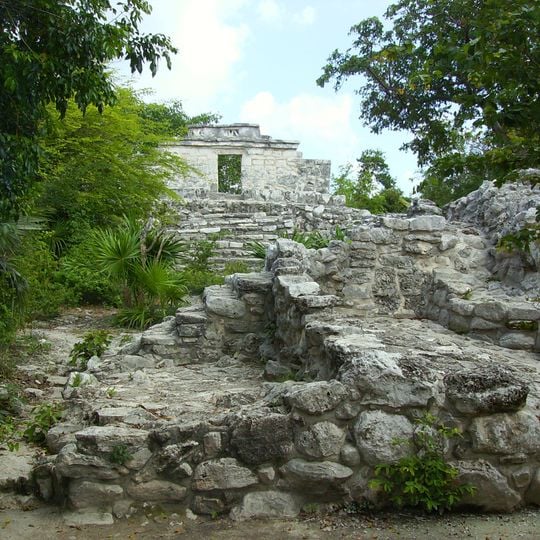
Xcaret is a Maya archaeological site in Solidaridad, Mexico, on the Caribbean coast of Quintana Roo. Its rough limestone terraces and low walls rise to a flat-topped facade with a rectangular doorway; a small dark opening sits near the top. The site lies within the privately owned Xcaret Park, which opened in December 1990.
Xcaret, originally called Polé, was a Maya port and trading centre on the Quintana Roo coast. INAH research dates the first buildings to 200–600 AD, while most structures belong to the Late Postclassic, 1200–1550. A wall closed off the seaward approach, unlike Tulum's ocean-facing wall. The site was inhabited when Alonso Dávila and Francisco de Montejo entered the eastern coast in 1527–1529; in 1548 Juan Núñez took charge and a Spanish chapel was built, whose walls still stand.
The name Xcaret means "small inlet" in Maya, while its old name Polé comes from p'ol, meaning merchandise or merchants' dealings. Maya pilgrims departed from here for Cozumel to worship Ix Chel, the goddess of fertility and the moon. Each May the park stages the Sacred Maya Crossing, reenacting that pilgrimage with four-person rafts and wooden oars.
The archaeological zone lies within the Xcaret theme park, 5 km south of Playa del Carmen and 75 km south of Cancún. Access is through the park's ticket system, not public roads. The ruins stand near the coast, with some structures in the jungle interior. The park opened in December 1990 after archaeologists from INAH restored the Maya buildings.
The chapel walls still stand roofless; excavations led by archaeologist María José uncovered 135 human remains inside. DNA from the site resembles that of present-day Maya of the Yucatán more closely than ancient Copán populations, which lack mtDNA lineages A and B.
The community of curious travelers
AroundUs brings together thousands of curated places, local tips, and hidden gems, enriched daily by 93,339 contributors worldwide.