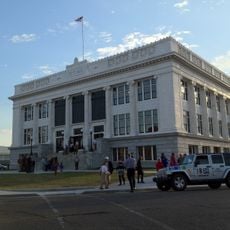
Riley Center, Opera house in downtown Meridian, United States.
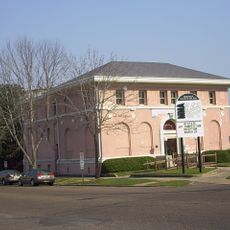
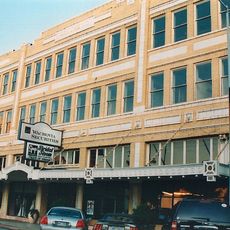
The Riley Center, also known as the Grand Opera House, occupies a late Victorian building with a mansard roof and an exterior designed by Gustavus Maurice Torgerson. Its interior, by J.B. McElfatrick, includes a stage 30 feet wide by 50 feet deep under a 35-foot arched proscenium. The complex combines the restored theater with the adjacent former Marks-Rothenberg department store, now a conference facility.
The Grand Opera House and the adjoining Marks-Rothenberg department store were built in 1889 by half-brothers Israel Marks and Levi Rothenberg, with interiors by theater architect J.B. McElfatrick. It opened on December 17, 1890, with Johann Strauss's operetta The Gypsy Baron, performed by a German-language company from New York. Remodeled in 1902 and converted partly to a movie theater in 1920, it was listed on the National Register of Historic Places in 1972.
The painted "Lady" above the proscenium became the opera house's emblem, and locals call the building "The Lady." Early audiences saw Sarah Bernhardt in La Tosca and Ibsen's Ghosts, while minstrel shows drew the largest crowds. Seating was segregated, though African-American troupes such as Black Patti also performed.
The center welcomes visitors during performances and special events throughout the year. The best time to visit is during a scheduled show, when you can experience the interior spaces and architectural details.
The painted border above the 35-foot arched proscenium carried an image known as the "Lady," which became the Opera House's symbol; in the 21st century the building is affectionately called "The Lady." The silver screen installed for the 1920 conversion to a movie theater can still be seen in the backstage area.
The community of curious travelers
AroundUs brings together thousands of curated places, local tips, and hidden gems, enriched daily by 94,047 contributors worldwide.