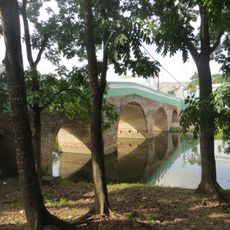
Jardín Botánico de Cienfuegos, Tropical botanical garden in Cienfuegos Province, Cuba
The Botanical Garden of Cienfuegos is a sprawling green space divided into distinct sections, each featuring different plant families and growing environments typical of the tropics. Pathways guide visitors through areas dedicated to orchids, palms, cacti, and bamboo, allowing close observation of how these diverse species are organized and maintained.
Edwin F. Atkins, a US sugar entrepreneur, bought the old Soledad del Muerto sugar mill and opened the Harvard Botanical Station for Tropical Research and Sugar Cane Investigation in autumn 1901 on about 4.5 hectares. He transferred its direction to Harvard University in 1919; Harvard left Cuba in 1960, when the Ministry of Industry and the Universidad Central Marta Abreu de las Villas took over. It was declared a National Monument on 20 October 1989.
The garden's name recalls Soledad, the sugar estate Edwin F. Atkins bought, and its palms carry popular names like "the walking tree," "elephant's foot," "monkey trap" and "the sausage tree." It was declared a National Monument on 20 October 1989 and remains a dependency of Cuba's Ministry of Science, Technology and Environment.
The garden lies about 14 km from Cienfuegos city centre, on the road to Trinidad beside the Central Pepito Tey sugar mill, at an elevation of 50 m. Its 97 hectares include 7 hectares of preserved natural forest, so plan for a long walk between the palm, orchid and ficus collections. Average annual rainfall is 1400 mm and the mean temperature 24.5 °C.
The garden maintains dedicated bamboo plantations featuring many distinct species, showcasing the surprising diversity within this single plant family. This bamboo section is often overlooked by visitors, despite offering an uncommon look at how varied these fast-growing plants can be.
The community of curious travelers
AroundUs brings together thousands of curated places, local tips, and hidden gems, enriched daily by 92,843 contributors worldwide.