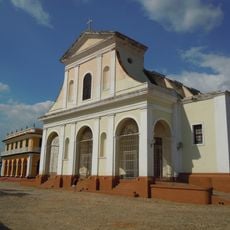
Catedral de Santa Clara de Asis, Gothic Revival cathedral in Santa Clara, Cuba.
The Catedral de Santa Clara de Asís stands on Calle Marta Abreu, two blocks from Parque Vidal and beside the cultural centre El Mejunje. Built in 1940 in a Neo-Gothic style, it has leaded stained glass windows, a marble baptismal basin known as the pilón, and a statue of Jesus above the entrance holding a gold monstrance. Inside is a larger-than-life statue of the Virgin Mary called la Virgen del camino.
The colonial Iglesia Mayor, built in 1738 in Parque Vidal, was demolished in 1923 to enlarge the plaza; the present church was built in 1940 in a style close to Neo-Gothic. Church authorities filed a formal complaint against the city and won, though the awarded compensation was never paid. On 1 April 1995 Pope John Paul II created the Diocese of Santa Clara and the church was raised to cathedral rank.
Locals baptized in the marble pilón kept in the cathedral are called "pilongos", a nickname tied to the basin used for most of the city's history. The larger-than-life Virgin Mary inside is known as "la Virgen del camino", the Travelers' Virgin, because it once stood on the road to Havana blessing those leaving the city.
The cathedral entrance is on Calle Marta Abreu, with the cultural center El Mejunje right next to it. The nearby Parque Vidal serves as a good landmark and makes it easy to find the church on foot from that point.
The larger-than-life statue of the Virgin Mary inside is known locally as "la Virgen del camino", the Travelers' Virgin. Until the Cuban Revolution it stood on the road to Havana to bless travelers; it was pulled down soon after and lost for over three decades, until it was found around 1995 in a ditch under soil and undergrowth. A dispute over whether it belonged to a museum or the church ended with it given to religious authorities.
The community of curious travelers
AroundUs brings together thousands of curated places, local tips, and hidden gems, enriched daily by 94,022 contributors worldwide.